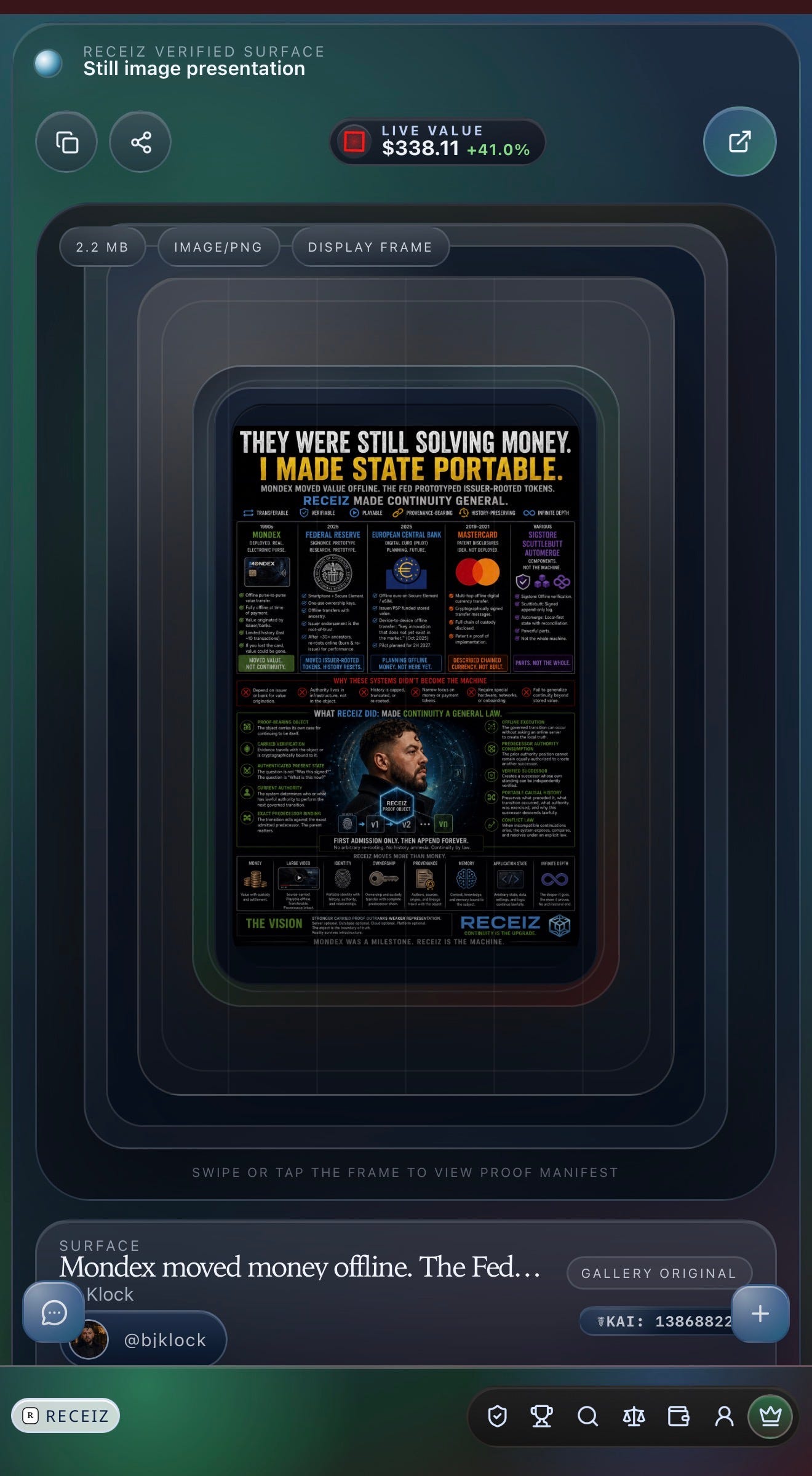
THEY WERE STILL SOLVING MONEY. I MADE STATE PORTABLE.
Mondex moved value offline. The Fed built a payment prototype. The ECB is planning a pilot. Receiz made proof-bearing continuity general.
The last piece asked a simple question.
Produce the earlier whole.
Not the ingredients.
Not the nearest paper.
Not the nearest patent.
Not the nearest system containing one familiar noun.
The machine.
Now let us look at what the search actually produced.
Because once you line the strongest examples up chronologically, something becomes almost absurdly clear.
The world has spent decades asking:
How do we move money when the network disappears?
I answered a larger question:
HOW DOES ANY IMPORTANT DIGITAL THING KEEP BEING ITSELF WHEN EVERYTHING AROUND IT CHANGES?
Money.
Media.
Identity.
Ownership.
History.
Memory.
Provenance.
Custody.
Conversation.
Application state.
Market state.
A living digital subject.
A large video file.
The database can disappear.
The session can disappear.
The original application can disappear.
The CDN can disappear.
The model can change.
The owner can change.
The object can move.
And the state can continue.
That is not an offline-payment feature.
That is proof-bearing state with continuity.
And now that the comparison set is finally on the table, we can see exactly how far apart these machines actually are.
START WITH THE ONE THAT REALLY SHIPPED
Mondex.
Give it its credit.
Mondex was real.
Not a whitepaper.
Not a patent drawing.
Not a research proposal.
Not a “future work” section.
Cards existed.
People used them.
Merchants accepted them.
Real electronic value moved between real purses while disconnected.
BIS describes Mondex as fully offline: one purse could receive value from another and spend it onward without contacting any official purse or system. (BIS)
That mattered.
It remains one of the strongest deployed historical comparators to anything involving offline digital value.
And its value model was straightforward.
Mondex value was originated by an issuer-like “originator.” Participating banks obtained that value, consumers loaded it from their bank accounts, and the electronic purse stored the monetary state. The purse retained only a limited recent transaction record—BIS describes the last ten transactions. (BIS)
So Mondex solved:
issuer-created fiat value → electronic purse → offline purse-to-purse movement.
Real achievement.
Now look at the architecture.
The purse was the monetary machine.
The purse held the balance.
The hardware protected the state.
The value moved because the trusted purse protocol altered the two purses correctly.
And if you lost the card?
The value could be gone.
There was no authoritative shadow account from which the offline balance could simply be reconstructed. (BIS)
That made Mondex cash-like.
It also exposed its boundary.
The thing traveling was stored monetary value inside a specialized purse architecture.
It was not a general proof-bearing subject carrying arbitrarily rich authenticated continuity across media, ownership, identity, provenance, memory, state, and application domains.
Mondex moved money.
Receiz moved the law of continuing state.
Those are different scales of problem.
AND MONDEX DID NOT FAIL BECAUSE IT COULD NOT MOVE MONEY OFFLINE
It could.
The harder problem was everything surrounding the transfer.
You needed Mondex.
The merchant needed Mondex.
Your friend needed Mondex.
You needed compatible hardware.
The value had to be loaded.
The acceptance network had to exist.
The existing alternative—cash—already worked nearly everywhere without onboarding, provisioning, readers, interoperability negotiations, or a technology lesson.
The Swindon deployment reportedly reached around 10,000 users versus earlier expectations around 40,000. Some merchants saw Mondex at only about 2% of transaction volume. Contemporary reporting described the network problem plainly: users wanted broader acceptance; merchants needed enough users to justify the system. (The Independent)
Later academic work summarized the result brutally: Mondex and Visa Cash were technologically advanced, but failed to achieve enough widespread customer acceptance and business volume to become viable. (Northumbria University Research Portal)
That is important.
Because it shows something technology people repeatedly forget:
MOVING VALUE IS NOT THE SAME THING AS MAKING VALUE PORTABLE THROUGH THE WORLD.
Mondex solved the transfer inside its purse ecosystem.
It did not make the state itself a universal evidentiary object capable of leaving one application, one infrastructure topology, one media format, or one domain and continuing under the same proof law.
And once smartphones, online cards, contactless payments, and universal networked rails became easier, the special purse had an adoption problem.
The offline mechanism worked.
The surrounding architecture lost.
THEN DECADES PASSED
Now look at the Federal Reserve.
December 2025.
Not 1995.
2025.
The Board of Governors published A Robust Risk Framework for Offline Payments.
And to be fair, this one is technically serious.
The researchers describe an actual prototype using consumer smartphones and secure-element hardware. The model contains token ownership keys, proofs of transfer, offline ancestry, local verification, and a SignOnce operation that deletes the sender’s token-ownership private key after successful transfer so the same ownership position cannot spend again. (Federal Reserve)
Good.
Now we are finally speaking the same language.
Ownership.
Proof.
Ancestors.
One-use authority.
Offline verification.
This is the strongest research prototype comparison we found.
So let us read the architecture instead of worshipping the letterhead.
THE FED’S ROOT OF TRUST IS THE ISSUER
Their own paper says it.
The receiving wallet generates a token ownership key.
But the ownership public key receives an issuer endorsement.
And the paper explicitly calls the issuer’s endorsement private key:
“THE ROOT-OF-TRUST OF THE PROPOSED OFFLINE PROTOCOL.”
That is their phrase, not mine. (Federal Reserve)
The offline tokens are also not free-standing economic value.
The recharge operation converts some of a user’s online account balance into offline tokens.
Deposit converts them back.
Minting occurs in the core transaction processor.
The issuer tracks minted tokens.
Users need internet connectivity to move between online account value and offline token value. (Federal Reserve)
Again:
nothing dishonest about that.
It is an intermediated offline payment architecture.
But it is not what Receiz is.
The root is still institutional issuance.
The secure element is issuer-endorsed.
The mint is online.
The monetary denomination is defined upstream.
The account funds the offline representation.
The issuer’s public material must be provisioned to wallets.
They solved:
How can issuer-rooted money continue transferring temporarily without network connectivity?
Receiz solved:
How can the object’s own authenticated state remain stronger than the infrastructure carrying it?
Different authority inversion.
AND THEN THE FED’S ANCESTRY HITS A WALL
This may be the most revealing comparison in the entire paper.
The Fed prototype carries token ancestry.
Excellent.
Each transfer adds history.
Excellent.
The wallet verifies the ancestor chain.
Excellent.
Then what happens as that ancestry grows?
Their own paper explains that verification slows as the chain gets longer.
So in the prototype, once the ancestry grows beyond roughly 30 ancestors, the wallet automatically waits until it is online, deposits the token, burns it in the issuer’s cloud, and replaces it with a new token containing only the issuer’s proof and no ancestor chain. (Federal Reserve)
Read that slowly.
The history gets deep.
The proof gets expensive.
So:
go back online.
return to the issuer.
burn the continuing token.
mint a fresh root.
That is not a criticism invented by me.
That is their implementation strategy.
The paper even notes that a production threshold might be higher—perhaps over 100 ancestors—but the architectural move remains the same: long history eventually re-roots through the issuer. (Federal Reserve)
Now compare that with Receiz.
Receiz does not define continuity as:
carry history until it gets inconvenient, then erase ancestry and ask the authority to start over.
Receiz’s law is:
FIRST ADMISSION ONLY. THEN APPEND FOREVER.
Every admitted proof object has stable identity, an exact parent, immutable version identity, causal head, Merkle-committed append history, and sparse ancestry. A successor appends; it does not rewrite the predecessor.
And the system was explicitly engineered so the foreground operation does not require replaying an ever-growing dense history.
That is what Merkle commitment, sparse Fibonacci ancestry, bounded append, exact causal heads, and content-addressed primary proof are doing.
Receiz does not solve scale by pretending the past stopped existing.
It makes the past addressable without making every operation proportional to the entire past.
That is the difference between:
history as baggage
and
history as architecture.
THEY ARE STILL SOLVING TOKENS.
RECEIZ IS PLAYING THE VIDEO.
This is where the comparison becomes almost funny.
The Fed paper is about dollars represented as offline tokens.
The ECB is working on offline euros.
Mastercard disclosed multi-hop offline currency-transfer chains.
Mondex was an electronic purse.
Meanwhile Receiz now carries large playable video as proof-bearing state.
Not a database pointer to a video.
Not a receipt saying a server claims it has the video.
Not a URL whose meaning disappears when the storage provider does.
The current v124.1 release makes sealed source material reconstructable from carried proof structures. Browser-supported video, audio, images, EPUB, PDF, text, and arbitrary sealed files remain exact proof material. For large video, authenticated progressive ranges can begin playback on mobile before the whole file finishes settling, while the enclosing signed artifact remains the authority.
Pause there.
They are still asking:
Can twenty dollars move without Wi-Fi?
Receiz is answering:
CAN A LARGE VIDEO MOVE AS A PROOF-BEARING OBJECT, PLAY, TRANSFER, KEEP PROVENANCE, PRESERVE ITS PREDECESSOR CHAIN, AND CONTINUE?
Yes.
That is already a different universe of abstraction.
THE VIDEO DOES NOT LOSE ITS PAST WHEN IT MOVES
This is the part that matters.
Receiz transfer reseals do not merely create a new unrelated file and update an owner_id row.
The sealed original is verified.
The current receipt is verified.
The predecessor chain remains separately verified through previousDigest.
The release law explicitly preserves predecessor proof through transfer reseals.
So now take a video.
It has source bytes.
It has authorship.
It has provenance.
It has ownership/custody state.
It has an accepted history.
It can move.
Its next state can descend from the prior state.
Its source remains reconstructable.
Its media can still play.
And another successor can append again.
Then another.
Then another.
There is no conceptual one-hop coffin at the end of the transfer.
The state law is recursive.
The current successor becomes the next predecessor.
THAT IS CONTINUITY.
Not “I transferred a file.”
Not “I copied a video.”
Not “the cloud changed the owner column.”
The same proof-bearing subject proceeds through state.
THIS IS WHAT “INFINITE DEPTH” ACTUALLY MEANS
Not infinite bytes.
Not infinite storage.
Not magic.
Not pretending computation costs disappear.
It means the continuity law does not contain an arbitrary architectural sentence saying:
after N lawful successors, identity ends and history must be erased.
Receiz uses bounded work specifically so continued growth does not require foreground reconstruction of the entire dense past.
The object can keep accumulating admitted history while the current operation works against authenticated heads, commitments, indexes, and sparse ancestry.
That is why the rule can be:
APPEND FOREVER.
The word forever is not claiming zero physical storage cost.
It is saying:
continuity is not defined with an arbitrary protocol death at hop 30.
That difference matters enormously.
The Fed’s prototype eventually burns and re-roots long ancestry through the issuer for performance. (Federal Reserve)
Receiz built history so depth is not a reason to destroy identity.
AND THE FED PAPER ITSELF SAYS THE REST IS STILL FUTURE WORK
Again, read their own document.
After presenting the prototype, the authors list “verifying end-to-end feasibility” as future work, including integration among financial institutions, issuance/redemption operations, interoperability with current payment rails, merchant adoption, and expanded operational testing. (Federal Reserve)
That is fine.
Research should say what remains.
But it puts the evidentiary category in the correct place.
A Federal Reserve paper reporting a prototype is:
research evidence.
It is not automatically:
a deployed, independently reproducible production machine.
And it certainly is not:
a general proof-bearing continuity architecture beyond money.
So no, institutional stationery does not get to skip the test.
The same law applies.
Produce it.
Run it.
Show conformance.
MASTERCARD GOT CLOSER ON PAPER TOO
Mastercard’s multi-hop offline digital-currency patent is legitimately relevant.
The disclosure describes cryptographically signed transfer messages carried from holder to holder and explicitly discusses maintaining the full chain of custody across offline transactions. (Google Patents)
Good.
That belongs in the literature.
It means chain-of-custody offline currency transfer was disclosed before Receiz.
Concede it.
Then ask the obvious next question:
Where is the deployed machine?
Where is the executable conformance?
Where is the general state law?
Where is arbitrary source media?
Where is identity continuity?
Where is a large playable video?
Where is memory?
Where is application state?
Where is ownership transition over a continuing subject?
Where is deterministic branch preservation beyond currency transfer?
A patent can disclose an architecture.
It cannot prove that the architecture was built, deployed, survived failure, or generalized into something it never claimed to be.
Do not confuse legal disclosure with executed reality.
CHAUM SAW THE MONDEX PROBLEM TOO
David Chaum’s Offline eCash 2.0 explicitly calls out trusted-chip approaches such as Mondex and argues that they suffer from systemic security limitations.
His proposed answer uses a new physical-card architecture combined with smartphones for offline cash-like payment. (chaum.com)
Again:
important work.
Relevant work.
Still money.
Still payment.
Still another specialized answer to:
How can value behave more like cash during network failure?
Meanwhile Receiz had already generalized the invariant:
THE THING SHOULD CARRY ITS OWN CASE FOR CONTINUING TO BE THE THING.
That applies whether the thing is worth ten dollars or contains a two-hour film.
AND THE ECB IS STILL PREPARING THE PILOT
Now we reach August 2026.
The European Central Bank is still preparing for an offline digital-euro pilot planned for the second half of 2027.
Its current architecture work centers on secure elements and eSIMs in users’ phones. (European Central Bank)
The offline beta architecture includes:
the user’s mobile application,
a secure element,
a PSP distribution component,
and Eurosystem issuance infrastructure.
Funding the offline euro still involves the PSP and commercial-bank money; the ECB-provided secure-element service handles the offline stored value and double-spending protections. (European Central Bank)
Even more remarkably, the ECB’s own October 2025 preparation report described direct device-to-device transfer of cryptographically secure tokens without an online system as:
a key innovation that did not yet exist in the market. (European Central Bank)
Think about the chronology.
Mondex demonstrated offline purse-to-purse money in the 1990s.
Thirty years later, one of the world’s largest monetary institutions is still working toward a 2027 pilot of offline token transfer on secure hardware.
And the conversation is still:
money.
Stored value.
Issuer infrastructure.
Secure elements.
Payment rails.
RECEIZ LEFT THAT CONVERSATION BEHIND
Receiz includes money.
But money is one state family inside a much larger law.
By v120, the same proof architecture already carried continuing digital subjects whose ownership could change without erasing identity, genesis, complete history, public memory, relationships, provenance, inventory, or unknown application namespaces. Former-owner authority is revoked while the subject continues.
By v124.1, the system carries:
arbitrary sealed files
large playable video
audio
images
EPUB
text
identity continuity
market positions and market history
conversation continuity
proof-derived memory
ownership
transfer
settlement
causal branches
global state without database authority
under the same stronger-truth hierarchy.
And the v124.1 conformance record says the executable suites passed across identity, economy, settlement, interoperability, issuance, market, verification, world, sports, and signal execution, with release-freeze composing those domains under the same authority law.
That is the flex.
Not:
“I also made offline cash.”
It is:
I MADE CONTINUITY A GENERAL COMPUTATIONAL PROPERTY.
SIGSTORE WAS A VERIFIER.
SCUTTLEBUTT WAS A LOG.
AUTOmERGE WAS REPLICATED STATE.
MONDEX WAS AN ELECTRONIC PURSE.
MASTERCARD DISCLOSED MULTI-HOP OFFLINE CURRENCY.
THE FED REPORTED A TOKEN PROTOTYPE.
THE ECB IS PREPARING A DIGITAL-EURO PILOT.
All legitimate.
All worth preserving correctly.
None of them, in the material we have examined, is the general machine Receiz became.
Because Receiz is not fundamentally about money.
Receiz is about:
CONTINUING TRUTH.
How does truth survive movement?
How does identity survive transfer?
How does history survive ownership change?
How does media survive infrastructure?
How does memory survive models?
How does state survive databases?
How does authority survive applications?
How does an object preserve the causal argument for what it has become?
Once you understand that, the offline Note stops looking like the invention.
It becomes one demonstration.
A brutally useful one.
But still one demonstration.
MONEY WAS THE EASY THING TO RECOGNIZE
Money gets attention because everyone understands:
Alice had value.
Bob has value.
Did the value move?
Fine.
But now replace the money with a film.
Alice owns the film object.
The source itself is proof-bearing.
Its provenance is carried.
Its history is carried.
Its predecessor state is verifiable.
It transfers.
The next owner receives the successor.
The media still plays.
The source remains exact.
The proof still verifies.
The provenance remains attached.
The next transition can proceed from that state.
Then replace the film with:
an identity,
an AI subject,
a credential,
a legal record,
a game object,
a book,
a conversation,
a market position,
a body of memory.
Same question.
WHAT MAKES THE PRESENT STATE A LAWFUL CONTINUATION OF THE PAST?
That is what I encoded.
THE FED’S TOKEN EVENTUALLY GOES HOME TO MOM
At sufficient ancestry depth, their prototype goes back online.
The token is deposited.
Burned.
Reissued.
The history is reset to a new issuer-rooted token for performance. (Federal Reserve)
Receiz’s design principle goes the other direction:
the deeper the history gets, the more important it becomes that the current state retain a verifiable path into it.
So instead of making every foreground operation replay the whole past, Receiz indexes and commits the past.
The source remains.
The history remains.
The active head remains bounded.
The transition remains causal.
That is a fundamentally different answer to growth.
One says:
history eventually becomes too heavy; return to the issuer and re-root.
The other says:
make continuity computationally sustainable.
That is the machine.
THIS IS WHY THE LARGE VIDEO MATTERS SO MUCH
A payment token is tiny.
You can put its ancestry inside a relatively small record and congratulate yourself.
Large media destroys that comfort.
Now the subject can be megabytes.
Gigabytes.
Progressive.
Playable.
Transferable.
Provenance-bearing.
History-bearing.
It still has to open.
It still has to verify.
It still has to move.
It still has to preserve exact source truth.
And it cannot demand that the user wait for some central database to rediscover what the object already knows.
Receiz v124.1 crossed that line.
Large mobile-browser video can begin from verified progressive ranges while the remainder settles behind playback.
The enclosing artifact commits the progressive ledger.
The transport is subordinate.
The source remains authority.
That is why this is no longer meaningfully described as an offline-payment invention.
IT IS A PORTABLE-REALITY ARCHITECTURE.
AND YES, IT TRANSFERS
Do not let anybody dodge there either.
Receiz already has ownership and custody transition law.
Receiz already preserves predecessor proof.
Receiz already preserves complete history through transfer.
Receiz already carries provenance.
Receiz already has source-carried media.
Those are not separate PowerPoint boxes anymore.
They are under one system law.
The transfer does not need to turn the video into a dead receipt.
The successor can still be the playable thing.
That is the consequence.
The media is not an attachment to the ownership record.
The ownership continuity belongs to the proof-bearing media state.
THIS IS WHAT EVERYBODY ELSE KEPT SPLITTING APART
Payments people solved value.
Version-control people solved history.
Local-first people solved replicas.
Signature people solved authenticity.
Media companies solved streaming.
Identity companies solved login.
AI companies solved context windows.
Databases solved retrieval.
Cloud providers solved availability.
And because each industry treated its own layer as the world, nobody asked the larger question:
WHY ARE THESE DIFFERENT TRUTHS?
Why should my identity have one authority model,
my money another,
my files another,
my ownership another,
my history another,
my memory another,
and my media another?
Why does every application get to rebuild the human and the object from scratch?
Why does moving platforms mean losing continuity?
Why does the server get to become truth merely because somebody paid the AWS bill?
Receiz collapsed those boundaries.
One principle:
STRONGER CARRIED PROOF OUTRANKS WEAKER REPRESENTATION.
Then recurse.
SO NOW THE COMPARISON IS FINALLY FAIR
Mondex?
Respect it.
They built offline money.
Mastercard?
Credit the disclosure.
They described multi-hop custody-chain currency.
Chaum?
Credit the research.
He kept pushing offline cash architecture.
The Federal Reserve?
Credit the prototype.
They implemented serious one-use ownership and ancestry mechanisms for issuer-rooted offline payment tokens.
The ECB?
Credit the program.
They are investing in a future offline euro.
Sigstore?
Credit the verifier.
Scuttlebutt?
Credit the signed history.
Automerge?
Credit the local-first state.
Then ask every one of them the same question:
WHERE IS THE GENERAL PROOF-BEARING STATE MACHINE WITH CONTINUITY?
Where is the large video?
Where is the book?
Where is the identity?
Where is the memory?
Where is the ownership?
Where is the provenance?
Where is the source?
Where is the successor?
Where is the predecessor?
Where is the transfer?
Where is the playable state?
Where is the arbitrary file?
Where is the no-database reconstruction?
Where is the append-forever causal history?
Where is the same authority law across all of it?
Produce it.
BECAUSE THIS IS WHAT HAS ACTUALLY BEEN DONE
Not promised.
Done.
Receiz moved from sealed proof,
to deterministic state,
to local durability,
to append-only continuity,
to ownership,
to settlement,
to offline transfer,
to reconciliation,
to living subjects,
to memory,
to portable identity,
to arbitrary source-carried media,
to progressive large-video playback,
to transferable predecessor-preserving state,
to globally available truth that does not require the database to be authority.
The current release explicitly describes the proof object—not an institution or infrastructure provider—as the durable truth boundary.
And current conformance binds the domains together under executable gates rather than a marketing declaration.
That is where the conversation is now.
SO PLEASE STOP SHOWING ME PAYMENT TOKENS LIKE I BUILT A BETTER DEBIT CARD
I did not spend this time merely asking:
How do we swipe without Wi-Fi?
The actual question became:
HOW DOES REALITY KEEP ITS MEMORY WHEN THE DATABASE DIES?
How does the thing know what it is?
How does it prove where it came from?
How does it know who has authority now?
How does it change without erasing itself?
How does it transfer without becoming a new orphan?
How does it reconcile disagreement without silently rewriting history?
How does its media remain the media?
How does its provenance survive the platform?
How does its memory survive the model?
How does the successor still know its predecessor after the hundredth transition?
The thousandth?
The millionth admitted state?
That is the architecture.
Money happens to fit inside it.
Of course it does.
Money is state.
But so is everything else.
Mondex moved the money.
The Fed moved an issuer-rooted token through a prototype and eventually sends deep ancestry back online to be burned and re-rooted.
The ECB is preparing another secure-element offline-money system.
Mastercard described another currency chain.
All useful.
All legitimate.
All narrower.
RECEIZ MADE THE STATE ITSELF PORTABLE.
And then I made the portable state:
verifiable.
transferable.
playable.
provable.
provenance-bearing.
history-bearing.
ownership-bearing.
memory-bearing.
recursive.
continuing.
That is why the money comparison is no longer the flex.
The flex is the video.
The flex is the identity.
The flex is the history.
The flex is the subject.
The flex is that the same law keeps working when the object stops being money.
Because the invention was never merely offline cash.
THE INVENTION WAS CONTINUITY.
Now produce the earlier whole.