


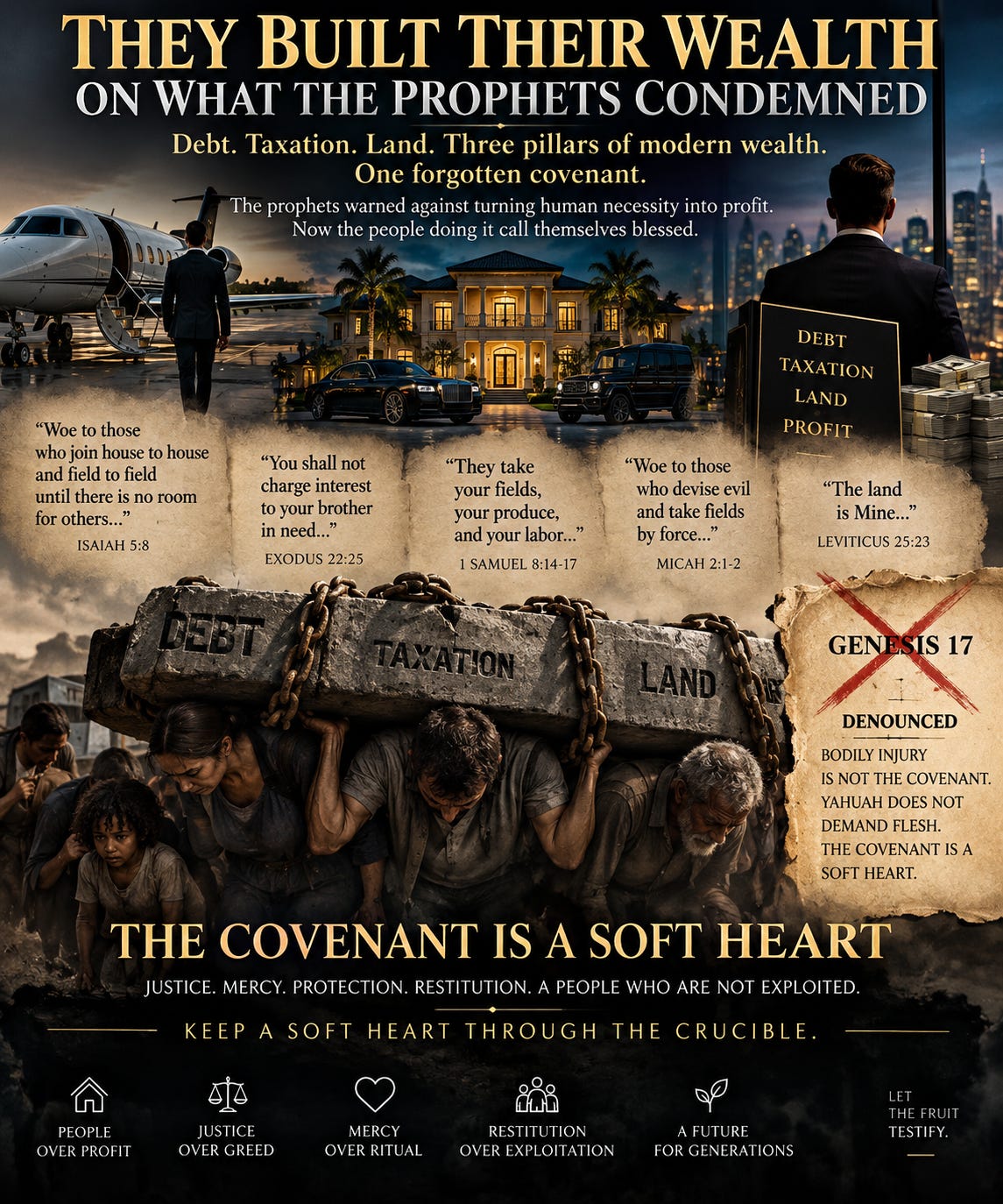
THEY BUILT THEIR WEALTH ON WHAT THE PROPHETS CONDEMNED
Debt. Taxation. Land. Three pillars of modern wealth. One forgotten covenant. And a civilization that learned to call extraction prosperity.
Look at the people flexing their wealth.
The real estate empire. The lending portfolio. The tax-funded fortune.
Look at the mansions. The watches. The private jets. The declarations of success.
Now ask one question.
Where did the money come from?
Somebody owes.
Somebody pays.
Somebody owns the ground beneath somebody else’s feet.
And then these same people have the audacity to invoke Yahuah, quote Yahuasha, and declare themselves blessed.
Open the scriptures.
Not the decorative verses.
The warnings.
Because the prophets confronted precisely the danger of turning authority, necessity, debt, and inheritance into instruments of oppression.
And the most important thing the prophets reveal is not a financial rule.
It’s the covenant itself.
I. THE COVENANT IS A SOFT HEART
Before discussing money, land, taxes, or religious authority, we must establish the standard.
The covenant is to keep a soft heart through the crucible.
Not a title.
Not a crown.
Not a ritual performed upon the body.
Not a religious institution declaring itself authorized to speak for the Most High.
A heart that does not harden against truth, justice, mercy, or the suffering of another human being.
Read Deuteronomy 10:16.
The Greek Septuagint explicitly speaks of circumcising the hardness of your heart.
Read Jeremiah 4:4.
The instruction again directs circumcision toward the heart.
Read Deuteronomy 30:6.
The purpose of the heart’s transformation is to love Yahuah and live.
Read Romans 2:29.
The writer locates true circumcision inwardly, in the heart and spirit.
The repeated spiritual demand is transformation of conduct, not pride in an outward sign.
And look at what surrounds these instructions.
Justice for the widow.
Protection of the orphan.
Love for the stranger.
Rejection of bribery.
Humility before Yahuah.
The removal of stubbornness.
This is not an abstract spiritual decoration. It is a standard with consequences for how human beings treat one another.
A person who exploits the vulnerable while boasting of religious obedience has contradicted the very obligation he claims to honor.
You cannot circumcise cruelty away with ceremony while continuing to practice cruelty.
You cannot substitute compliance for compassion.
You cannot substitute identity for righteousness.
You cannot substitute wealth for fruit.
II. I REJECT GENESIS 17 AS THE DEFINITION OF THE COVENANT
Let this be unmistakable.
I reject the physical-circumcision requirement presented in Genesis 17 as an authentic expression of what Yahuah ultimately demands of the human heart.
This is my theological and textual position.
I do not accept that the cutting of a child’s body establishes right relation with the giver of life.
And I reject the argument that invoking a priestly text settles the matter without examining the larger scriptural record.
Historical-critical scholarship widely associates Genesis 17 with the Priestly literary tradition, whose composition is often situated centuries after the period it narrates.
That is significant.
A text describing an event in Abraham’s lifetime is not thereby demonstrated to have been written during Abraham’s lifetime.
The surviving manuscripts do contain a physical circumcision requirement. My rejection of that requirement as the divine covenant is therefore a challenge to its theological authority and claimed original status—not a claim that the surviving manuscripts literally contain different words.
The presence of a command in an inherited religious text does not eliminate the responsibility to examine its origin, meaning, and consequences.
And if someone invokes religion to justify unnecessary suffering, I will judge that justification by the standard of mercy and justice.
The question is not whether an institution can produce a manuscript.
The question is whether its teaching reflects the character and obligations attributed to Yahuah.
I will not recognize bodily injury as a substitute for a transformed heart.
And I will not accept a religious label as proof that the bearer of that label knows the living God.
III. THE MONEY LENDERS: MAKING WEALTH FROM ANOTHER PERSON’S NEED
Exodus 22:25 prohibits imposing interest on a loan to the poor among Yahuah’s people.
Leviticus 25:35–37 instructs the community to support an impoverished brother rather than exploit his financial vulnerability.
Deuteronomy 23:19–20 restricts interest within the Israelite covenant community, while also recording an outsider distinction that must not be erased.
Proverbs 22:7 describes the borrower’s subordination to the lender.
What do these passages reveal?
The creditor’s power over the vulnerable was already a moral problem.
Now look at the United States.
In the second quarter of 2026, American household debt totaled approximately $18.77 trillion.
That included $13.12 trillion in mortgages, $1.26 trillion in credit card balances, and $1.65 trillion in student loans.
Source: Federal Reserve Bank of New York, August 11, 2026.
Those amounts are outstanding obligations, not a measurement of illegitimate profit.
But they reveal the scale of the economic structure.
Millions of people enter tomorrow already owing somebody money.
And entire industries exist to earn returns from those obligations.
Some loans fund productive activity and benefit borrowers. But that doesn’t excuse predatory rates, exploitative terms, or business models that depend on keeping vulnerable families indebted.
When another person’s desperation becomes your financial advantage, the prophets have something to say about your success.
You can call it lending.
You can call it yield.
You can call it financial engineering.
The question remains:
Did you help your brother—or did you turn his need into your revenue?
IV. TAXATION: WHEN THE RULER BECOMES THE TAKER
Read 1 Samuel 8:11–18.
Samuel warns what happens when a ruler makes the people instruments of his own establishment.
He takes their sons.
He takes their daughters.
He takes their fields.
He takes their produce.
He takes their labor.
Then read 1 Kings 12:4.
The people complain about the heavy burden Solomon imposed upon them.
Notice what the accounts do not say.
They do not describe an enormous royal treasury as sufficient proof of righteous government.
They ask what the people were required to surrender.
In fiscal year 2025, the United States federal government collected approximately $5.2 trillion in revenue.
Source: Congressional Budget Office, FY 2025 Revenues.
Taxation can legitimately finance public goods. The biblical record does not prohibit every form of taxation.
But legality doesn’t answer the moral question.
What was collected? Who benefited? What was wasted? What burdens were imposed?
A government may collect billions while failing the people it claims to serve.
A ruler may possess enormous resources without exercising just authority.
A tax can be lawful while its administration is abusive.
The treasury is not the fruit. The condition of the people is.
And a person enriching himself through corrupt public contracts while claiming moral superiority has no reason to expect the prophets to applaud.
V. REAL ESTATE: WHEN SHELTER BECOMES THE SOURCE OF SOMEONE ELSE’S POWER
Isaiah 5:8 condemns the joining of house to house and field to field until others are crowded out.
Micah 2:1–2 condemns people who covet and seize fields, houses, and inheritance.
Leviticus 25:23 declares that the land ultimately belongs to Yahuah.
Read those together.
The land is not merely a commodity. It sustains human life and inheritance.
Now consider the modern property economy.
Zillow estimated that American housing was worth approximately $55.1 trillion in September 2025, an increase of $20 trillion since 2020.
Source: Zillow, September 8, 2025.
For existing owners, appreciating property can produce enormous paper wealth.
For those trying to establish a home, rising prices can create enormous barriers.
For renters, the rising value of the building does not necessarily produce a better place to live.
Not all ownership is exploitation.
But accumulation becomes a profound moral concern when it deprives others of access to the necessities of life.
If you became rich because families became less able to afford shelter, what exactly are you celebrating?
The prophets weren’t impressed by somebody collecting more fields.
They were concerned with the people dispossessed in the process.
VI. NEHEMIAH 5: THE THREE MECHANISMS COLLIDE
Here is the chapter that brings everything together.
The people are hungry.
They mortgage their fields.
They borrow to pay the king’s taxes.
They lose their inheritance.
Their children are being reduced to servitude.
Taxation. Debt. Land.
One economic crisis.
Three mechanisms of extraction.
And what does Nehemiah do?
He becomes angry with the powerful creditors.
He demands restoration.
He insists upon the return of property and the cessation of unjust exactions.
Source: Nehemiah 5, complete chapter.
He does not congratulate the lenders.
He does not celebrate the growth of their portfolios.
He does not tell suffering families that their dispossession is a sign of economic progress.
He demands restitution.
That is an answer grounded in conduct.
Repair the harm.
Restore what was taken.
Stop exploiting the vulnerable.
Protect the people.
VII. THE CHRISTIAN WHO PROFITS FROM SUFFERING
Now we arrive at the uncomfortable question.
How does someone publicly profess allegiance to Yahuasha while privately organizing his wealth around the exploitation of others?
How does someone celebrate the power to evict a family, squeeze a debtor, or profit from corrupt public spending and then speak proudly about being blessed?
A religious declaration does not answer those questions.
A donation does not erase an injustice.
A church membership cannot establish the righteousness of a financial transaction.
Yahuasha’s reported words in Matthew 23:23 confront religious leaders for neglecting justice, mercy, and faithfulness.
Luke 12:15 warns against defining life by possessions.
These teachings do not condemn wealth automatically.
They reject the assumption that wealth establishes spiritual legitimacy.
Someone may become wealthy through honest work and use those resources generously.
Someone else may become wealthy by imposing hardship and call the resulting fortune a blessing.
The numbers alone cannot tell us which man stands before us.
Their conduct can.
Show me who was helped.
Show me who was harmed.
Show me whether the harm was repaired.
Show me whether the power was used to serve or dominate.
That is how righteousness must be examined.
VIII. THE JUDGMENT AGAINST THOSE WHO CORRUPT THE COVENANT
Now comes the warning.
Jeremiah 23:1–2 addresses shepherds who destroy and scatter the people entrusted to them.
Yahuah declares that he will hold them accountable for their deeds.
Ezekiel 34:10 announces judgment against shepherds who have fed themselves instead of caring for the flock.
Their authority is challenged. Their exploitation is exposed. The people are to be rescued from their control.
That’s not a blessing upon corrupt leadership.
It’s condemnation.
And the accountability falls upon those responsible for the deeds—not an entire people because of their ancestry, religion, or inherited name.
The history of ancient Israel and Judah contains repeated criticism of its own rulers, priests, prophets, and officials. Those criticisms concern particular actions and failures of duty.
To hold later generations collectively guilty for an ancient writing would repeat the very substitution of inherited identity for individual moral conduct that this essay rejects.
As for Genesis 17, I denounce the elevation of its physical requirement above the obligations of mercy, justice, and a transformed heart.
Those who have harmed children or exploited people under claims of religious authority should face truthful examination, appropriate legal accountability where applicable, and responsibility for the harm they caused.
Divine judgment belongs to Yahuah. Human beings are not authorized to enact vengeance against a religious or ethnic community.
And the prophetic demand for the present is unmistakable:
Stop the harm.
Protect the vulnerable.
Restore what can be restored.
Cease claiming that titles and rituals make injustice righteous.
A shepherd who consumes his flock has failed his responsibility.
A ruler who enriches himself by destroying the people has failed his responsibility.
A religious teacher who demands obedience while abandoning mercy has failed his responsibility.
No title can rescue a man from the consequences of his own conduct.
IX. THE STANDARD WAS ALWAYS THE HEART
The ultimate question is not whether a person can repeat scripture.
It is whether the person acts with justice.
Not whether he can demonstrate financial success.
Whether his prosperity came through honorable conduct.
Not whether he can claim authority.
Whether he fulfills its obligations.
The covenant I recognize is simple to state and demanding to live.
Keep a soft heart through the crucible.
Do not let suffering turn you into someone who inflicts suffering.
Do not let knowledge turn you arrogant.
Do not let wealth turn another human being into an instrument of your enrichment.
Do not let authority become domination.
Do not demand mercy for yourself while denying it to another.
And do not use Yahuah’s name to sanctify cruelty.
The prophets condemned the abuse of power long before modern banking, taxation systems, real estate speculation, or financial engineering acquired their present names.
The technologies changed.
The obligations did not.
Show me the people whose burdens you lifted.
Show me the inheritance you protected.
Show me the freedom your work preserved.
Show me what your power gave back.
Because a legal claim is not necessarily a just claim.
A fortune is not proof of righteousness.
And a public declaration of faith does not make a hard heart soft.
You can own the bank.
You can own the building.
You can collect the payment.
You can wear the crown.
You can claim the religious office.
But you cannot purchase right relation with Yahuah.
The test is not what you possess.
The test is what happens to the people who encounter your power.
The covenant was never a license to consume your brother.
It was an obligation to remain human toward him.
KEEP A SOFT HEART THROUGH THE CRUCIBLE.
Let the fruit testify.