


THE MEMORY WILL NEED A RECEIPT
AI Has Learned to Remember. The Next Problem Is Proving What It Remembered, Where It Came From, Who Changed It, What Existed Before the Change, and Whether the History Survives the Model and the Platform. I Am Publishing the Test Before the Industry Gets There.
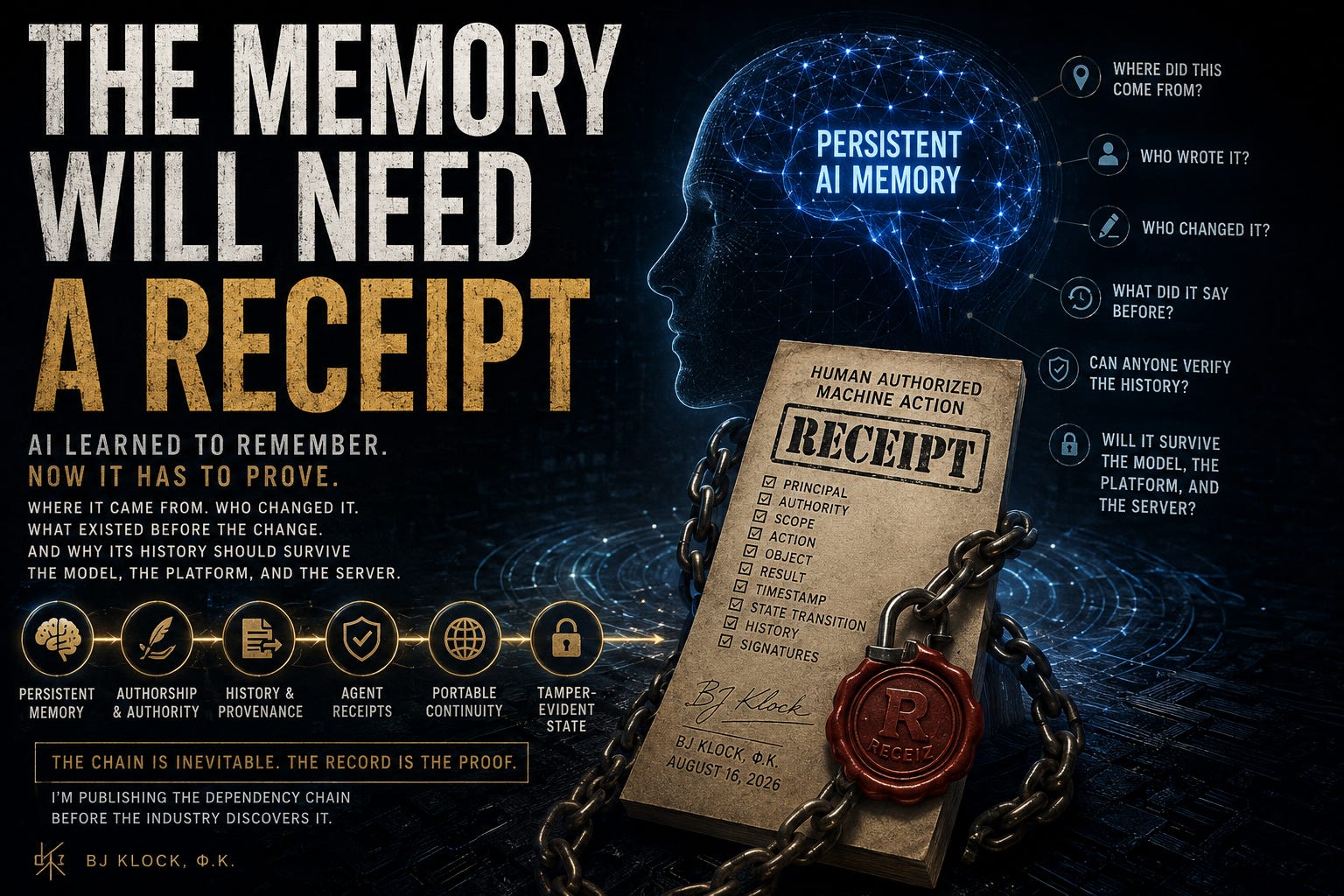
August 16, 2026

I am not writing this after the prediction became safe.
I am writing it now.
That distinction is the point.
For months I have been publishing the architecture beneath portable identity, provenance, ownership, authority, changing state, deterministic continuity, offline verification, persistent memory, and human-authorized machine action.
I have already made the historical claim precise.
I am not claiming that I invented signatures.
I am not claiming that I invented hashes.
I am not claiming that I invented files.
I am not claiming that I invented state machines.
I am not claiming that I invented memory.
I am not claiming that I invented AI agents.
I am not claiming that every ingredient appearing inside Receiz originated with me.
I claimed the working combination.
On July 22, I published THE CLAIM IS THE WORKING COMBINATION, explicitly separating the historical ingredients from the completed machine and freezing the requirement that any supposed predecessor produce the earlier whole rather than assemble a retrospective bag of parts. (BJ Klock)
I then published THE FIRST OFFLINE STATEFUL PROOF OBJECT, defining the category around a portable changing object whose authenticated identity, provenance, authority, ownership, transition history, present state, and competing continuations can be independently examined without giving the originating server discretionary authority over what is true. (BJ Klock)
Before that, on July 3, I published Agent Trust Infrastructure, stating the next agent problem plainly:
The important question would not merely be whether an AI could act.
The important question would be whether the human authorization, scope, action, changed object, result, and surviving receipt could be proven afterward. (BJ Klock)
Those records already exist.
This document is for what happens next.
Because the industry has now crossed another threshold.
And I do not want anyone waiting until the consequences are obvious before pretending the next requirement was obvious too.
THE INDUSTRY HAS LEARNED TO MAKE MEMORY PERSIST
That is no longer the prediction.
It has happened.
On June 4, 2026, OpenAI described its current ChatGPT memory architecture as a background process that synthesizes a memory state from many conversations, keeping that state current over time rather than relying only on explicitly saved notes. Users can inspect a summarized view of that synthesized memory and update the information it contains. (OpenAI)
OpenAI has also introduced memory sources that can expose some of the saved memories or prior chats used to personalize an answer. Importantly, OpenAI itself notes that this source view may not expose every factor that shaped the response. (OpenAI)
Anthropic is moving through the same territory from another direction.
On July 10, 2026, Anthropic changed Claude’s consumer memory from a daily summary into individual categorized entries that Claude reads and updates during conversations. (Claude Platform Docs)
Its developer memory tool goes further: persistent memory can be created, read, updated, deleted, reorganized, and carried across sessions through storage controlled by the application. (Claude Platform)
Anthropic has separately acknowledged that as more agent state persists across sessions, persistent memory itself becomes a security surface. It has specifically identified persistent-memory poisoning and is already asking broader questions about cross-platform agent identity. (Anthropic)
And Anthropic has published an agent architecture explicitly designed so components can be changed independently, describing a session as an append-only record while allowing implementations underneath the surrounding interfaces to be swapped. (Anthropic)
Good.
That is not evidence that these companies already built what I built.
It is evidence that the industry has now entered the exact territory in which the next missing primitive becomes unavoidable.
The problem is no longer:
Can the AI remember?
The problem becomes:
Can the memory prove what happened to it?
That is a radically different question.
THE MEMORY PROBLEM IS ABOUT TO BECOME AN EVIDENCE PROBLEM
Suppose an AI knows something about you today.
Where did that knowledge come from?
Did you explicitly say it?
Did the model infer it?
Was it synthesized from twenty conversations?
Was it imported from another service?
Was it written by another agent?
Did the system merge two memories?
Did it replace an old belief?
Was the old memory incorrect?
Was the new memory incorrect?
Who was allowed to change it?
What exactly existed before the change?
What happened between those two states?
Can you prove that sequence later?
Can another model consume the same state?
Can another company consume it?
Can you remove the original provider completely and still establish the history?
Can a verifier that neither trusts you nor trusts the platform independently determine whether the state is authentic?
Those questions barely matter when memory is disposable convenience.
They become foundational when memory starts controlling consequential action.
When the AI merely remembers that you prefer window seats, a bad memory is annoying.
When the AI remembers your financial obligations, business relationships, family structure, medical context, contractual constraints, preferences, ownership, permissions, prior approvals, unfinished work, recurring responsibilities, delegated authorities, and years of accumulated decisions, memory is no longer a cute personalization feature.
It is state.
And once memory becomes state, the next question is not how large the state is.
The next question is:
What makes the state trustworthy?
That is the prediction I am freezing here.
I AM NOT PREDICTING “BETTER MEMORY”
That prediction is worthless now.
I am not predicting longer context windows.
I am not predicting vector databases.
I am not predicting retrieval.
I am not predicting better summaries.
I am not predicting that AI companies will remember more information about users.
They already are.
I am making a narrower and much more consequential prediction.
Persistent mutable AI memory will force the industry to become concerned with provenance, historical state, authorship, authority, transition history, portability, and independent verification.
And I am publishing the expected sequence before that sequence becomes normal vocabulary.
It will happen because each previous solution creates the next unsolved problem.
Memory becomes persistent.
Persistent memory changes.
Changing memory creates historical state.
Historical state creates provenance questions.
Provenance creates authorship questions.
Authorship creates authority questions.
Authority creates lawful-transition questions.
Lawful transitions create receipts.
Receipts create verification requirements.
Verification independent of the original platform creates portability requirements.
Portability without trustworthy history creates counterfeit continuity.
And counterfeit continuity forces proof into the state itself.
That is the path.
Now I am freezing the checkpoints.
THE PROSPECTIVE LEDGER
The following predictions are being published on August 16, 2026.
The definitions matter because I am not interested in coming back later and calling every vaguely similar feature a hit.
A prediction should be capable of losing.
1. AI MEMORY WILL ACQUIRE HISTORY, NOT MERELY A CURRENT VALUE
Prediction window: by December 31, 2027.
At least one major frontier AI platform will expose materially better historical lineage for persistent machine-used memory.
A qualifying system must let a user, administrator, developer, auditor, or machine distinguish more than the current remembered value.
It must expose some meaningful part of the memory’s evolution:
where it originated;
whether it was explicitly supplied or inferred;
whether it was synthesized from earlier material;
whether it replaced an earlier persistent state;
or how the present persistent state relates to a previous one.
A current-response source indicator alone does not satisfy this prediction.
A delete button does not satisfy it.
An editable profile does not satisfy it.
A database timestamp saying a row changed does not satisfy it.
The prediction is about memory history becoming a product requirement because current memory alone becomes insufficient.
If no major frontier AI platform materially introduces that capability by December 31, 2027, this checkpoint fails.
Write that down now.
2. THE INDUSTRY WILL BE FORCED TO DISTINGUISH WHO WROTE THE MEMORY
Prediction window: by December 31, 2027.
Persistent state will increasingly need to distinguish among different classes of authorship.
Human assertion.
Model inference.
Model-created synthesis.
External source.
Imported system data.
Agent observation.
Correction.
Administrative override.
Potentially another machine actor.
The important distinction will not merely be informational.
It will become a trust distinction.
Systems will begin treating these sources differently because:
“I told the AI this”
is not equivalent to:
“the AI inferred this.”
“The user authorized this”
is not equivalent to:
“an autonomous process changed this.”
“the source record changed”
is not equivalent to:
“the summary changed.”
When persistent memory becomes consequential, systems will need rules for which actors may create, modify, supersede, contest, or revoke different classes of state.
A UI that merely lets the user manually edit a memory does not satisfy this prediction.
The prediction is that authorship and authority over memory become explicit system concerns.
If the industry can continue maintaining consequential mutable AI memory without materially distinguishing the origin and authority of state through December 31, 2027, this checkpoint fails.
3. EXPORTING CHAT LOGS WILL STOP BEING AN ADEQUATE DEFINITION OF PORTABILITY
Prediction window: by December 31, 2028.
People are going to accumulate too much useful state inside AI systems for “download your conversations” to remain a serious answer to portability.
A transcript is not continuity.
A pile of messages is not a mind state.
A ZIP archive is not a portable self.
The next portability layer will increasingly concern usable persistent state:
preferences;
relationships;
projects;
constraints;
decisions;
authorities;
semantic memory;
unfinished obligations;
identity context;
state transitions;
and the structured knowledge required for another intelligence to continue rather than merely reread.
A qualifying hit requires either a major AI provider or a broadly adopted interoperability project to support machine-consumable persistent user or agent state intended to initialize or continue another AI environment.
Exporting raw transcripts alone does not count.
A proprietary backup that can only be reimported into the same provider does not fully count.
The important transition is:
from exporting records of conversations to exporting continuity.
If no meaningful consumer or industry movement toward machine-usable continuity portability appears by December 31, 2028, this checkpoint fails.
4. AGENT AUTHORITY WILL HAVE TO BECOME RECEIPT-BEARING
Prediction window: by December 31, 2028.
The agent industry is currently captivated by capability.
Can the agent browse?
Can it buy?
Can it code?
Can it send?
Can it schedule?
Can it transfer?
Can it operate a computer?
Those are temporary questions.
The permanent question arrives afterward:
Under whose authority did it do that?
The serious agent infrastructure layer will increasingly need to bind:
the principal;
the machine actor;
the authority granted;
the relevant scope;
the object or system acted upon;
the action;
the resulting state;
and a durable record of the event.
Basic authentication does not satisfy this prediction.
An API key does not satisfy it.
A login session does not satisfy it.
A platform log saying “agent action completed” does not fully satisfy it.
The prediction concerns delegated authority becoming provable enough that responsibility can survive the session in which the action occurred.
I published that architecture before this prediction ledger.
On July 3, I called it Agent Trust Infrastructure and described the primitive as human-authorized machine action leaving a receipt. (BJ Klock)
I am now predicting that the wider agent ecosystem will be forced toward that same problem.
If consequential agents become common while the industry finds no meaningful need to bind principal, delegation, scope, action, and durable result by December 31, 2028, this checkpoint fails.
5. AI STATE WILL MOVE FROM AUDITABLE TO TAMPER-EVIDENT
Prediction window: by December 31, 2028.
This is the checkpoint I expect to arrive later because the industry can survive for a while by adding better logs.
But logs do not close the problem.
A log stored by the same institution whose behavior is being questioned still leaves the institution as the final witness to itself.
Eventually, at least one serious AI, identity, agent, provenance, or interoperability system will move from:
“we recorded what happened”
toward:
“changes to this history can be independently detected.”
That may arrive through cryptographic receipts.
Signed state transitions.
Attestations.
Hash-linked histories.
Proof-carrying artifacts.
Append-only state commitments.
Verifiable event chains.
Or some materially equivalent construction.
I am not predicting that everyone will use my names.
I am predicting the function.
A blockchain merely existing somewhere in the stack does not automatically satisfy this prediction.
A server-side audit log does not satisfy it.
A signature over a static export does not satisfy it.
The qualifying capability must materially improve the ability of an independent verifier to detect whether important persistent state or action history has been altered, substituted, omitted, or produced without required authority.
If that requirement does not emerge materially in serious AI-state systems by December 31, 2028, this checkpoint fails.
AND THEN THEY REACH THE REAL QUESTION
Assume all five happen.
Memory now persists.
Its history becomes inspectable.
Different authors and authorities are distinguished.
Continuity becomes portable.
Agents produce durable authorization records.
State becomes tamper-evident.
Now ask the final question:
Where does the authority to determine the lawful present reside?
If the answer is still:
“Ask our server,”
the problem is not solved.
If the answer is:
“Trust the database export,”
the problem is not solved.
If the answer is:
“Trust the dashboard,”
the problem is not solved.
If the answer is:
“Trust our signature that says the current file was the file we wanted you to have,”
you may have authenticated bytes without establishing the lawful history of the changing object.
The endpoint is not merely better cloud memory.
The endpoint is state capable of carrying enough authenticated history, authority, transition evidence, and governing law that its present can be independently established.
That is the territory I have already been building.
Receiz does not begin from:
“How do I make the model remember?”
It begins from:
What must the object carry so that the truth of its changing state does not disappear when the institution disappears?
That question turned out to reach identity.
Ownership.
Provenance.
Custody.
Authorization.
AI memory.
Agent action.
And continuity.
Because they were never separate problems.
They were all variations of the same missing primitive.
MEMORY IS NOT THE MODEL
This distinction will become increasingly important.
An intelligence can reason over a history.
That does not mean the intelligence is the history.
A model can interpret state.
That does not mean the model owns the state.
A model can synthesize memory.
That does not mean the synthesis should become the unquestionable source.
A model can improve.
A model can regress.
A model can be replaced.
A provider can change models underneath a product.
A provider can disappear.
A user can move.
The person’s continuity should not have to die each time the reasoning engine changes.
The industry is already approaching the architectural separation between reasoning components and surrounding persistent systems. Anthropic, for example, now explicitly describes agent infrastructure whose underlying implementations can be swapped while stable interfaces and session state remain. (Anthropic)
That separation is useful.
But there is another step.
The durable state cannot merely survive the model.
Eventually it must be able to survive the provider.
Otherwise we have replaced model captivity with platform captivity.
The intelligence should be replaceable.
The human should remain continuous.
HERE IS THE MODEL-SWAP TEST
I am freezing another test here because I do not want “the model is not the memory” to remain a slogan.
Take one exact persistent state.
Freeze it.
Seal its identity and head.
Give the same state to multiple unrelated reasoning models.
Ask a predefined set of questions requiring synthesis across the accumulated state.
The wording may vary.
The personality expressed by each model may vary.
The reasoning path may vary.
But historically grounded facts should remain grounded in the same source state.
Now append a genuinely new event.
Produce a new valid state.
Ask the questions again.
Any answer that should change because reality changed should change.
Any invariant that did not change should remain stable.
Now introduce another model that never participated in the first round.
Give it only the lawful current state.
If it can continue from that state without requiring the old model to remember anything, the distinction becomes visible:
the model was doing inference.
The state carried continuity.
Then remove the original reasoning model completely.
If continuity remains, the model was never the identity.
That is the test.
HERE IS THE INDEPENDENT-VERIFIER TEST
There is another objection worth destroying before anyone needs to make it.
If I publish the state law and I publish the verifier, someone can always attempt the lazy argument:
“Of course his verifier says his objects are valid.”
Fine.
Then do not trust my verifier.
Use the public specification.
Take a canonical conformance set containing, at minimum:
a valid object;
a byte-modified invalid object;
a valid authorized append;
an unauthorized transition;
a stale expected head;
two diverging continuations from a common valid history;
a reconciled continuation;
a state with broken history;
and a correct current head.
Now write another verifier from scratch.
Different code.
Different implementation.
Different developer.
No dependency upon my implementation.
Feed both systems the same objects.
If both independently derive the same validity judgments, reject the same invalid transitions, reconstruct the same lawful state, and arrive at the same relative histories, then the claim no longer depends on trusting the author of the original software.
The law is reproducible.
That matters.
I have repeatedly argued that institutions should not get to certify themselves.
The same standard should apply here.
Do not believe me.
Run the object.
Run the law.
Produce the answer.
WHAT DOES NOT COUNT AS PRIOR ART AFTER THIS
This record is also being written so the eventual convergence cannot be used to erase chronology.
When the industry begins introducing memory history, do not point backward to an old profile database and say:
“See? State existed.”
When the industry begins labeling inferred versus user-authored memories, do not point backward to CRUD permissions and say:
“See? Authority existed.”
When the industry begins producing agent receipts, do not point backward to an API log and say:
“See? Receipts existed.”
When portable continuity appears, do not point backward to a chat export and say:
“See? Portability existed.”
When persistent state becomes cryptographically verifiable, do not point backward to an isolated digital signature and say:
“See? Proof existed.”
And when the pieces finally converge, do not scatter backward through fifty years of computing, collect one ancestor for each ingredient, stack them in a pile, and announce that the completed whole had therefore always existed.
I already published the answer to that move.
Produce the earlier whole.
Produce the earlier working object.
Produce its state law.
Produce its authority succession.
Produce the changing history.
Produce its verifier.
Produce the offline reconstruction.
Produce the competing continuations.
Produce the agent authority trail.
Produce the portable continuity.
Produce the implementation.
Produce the dated record.
One machine.
Not archaeology conducted backward from mine.
THE WORDS MAY CHANGE
This matters because future convergence will not necessarily reuse my vocabulary.
They may call memory provenance something else.
Memory lineage.
State history.
Memory receipts.
Trust metadata.
Identity context.
Durable context.
User state.
Agent state.
Portable profile.
Continuity layer.
Context graph.
Personal knowledge substrate.
AI passport.
Agent identity.
Authorization chain.
Verifiable execution.
Cryptographic auditability.
Portable intelligence state.
Persistent personal context.
Fine.
Names are representations.
I am recording the function.
If a future system allows persistent identity-bearing state to accumulate, distinguishes its source and authority, preserves lawful transitions, survives changes in reasoning models, travels across surfaces, supports human-authorized machine action, carries durable evidence of what happened, and can be independently verified without granting the originating server discretionary authority over the answer—
changing the nouns does not make the architectural convergence disappear.
That is precisely why I am writing the test in functional terms.
THE FAILURE CONDITIONS MATTER
I am making predictions that can fail because there is no value in publishing prophecy that can absorb every possible future.
If persistent AI memory remains essentially a collection of opaque mutable provider-controlled summaries and no meaningful demand for historical lineage emerges, Prediction One fails.
If authorship and authority over consequential machine memory never become material system distinctions, Prediction Two fails.
If users remain satisfied treating conversation exports as sufficient portability and machine-usable continuity never becomes a meaningful category, Prediction Three fails.
If autonomous agents can perform consequential actions at scale without creating pressure for durable delegated-authority records, Prediction Four fails.
If database logs remain permanently sufficient and serious AI state never moves toward independently detectable tamper evidence, Prediction Five fails.
Those are real conditions.
Save them.
I want the future comparison.
WHY I AM DOING THIS NOW
Because chronology becomes strangely negotiable after something works.
Before the requirement becomes obvious, it sounds excessive.
After the requirement becomes obvious, it sounds inevitable.
Then inevitability gets confused with prior existence.
Those are not the same thing.
An invention can become inevitable because someone exposed the missing structure.
A category can become obvious because somebody built the thing that made the absence legible.
A problem can look trivial only after someone has already supplied the language required to see it.
So I am removing hindsight from the experiment.
Today is August 16, 2026.
OpenAI has persistent synthesized memory and has begun surfacing some of the sources used in personalization. (OpenAI)
Anthropic has persistent updateable memory and is already publicly confronting the security consequences of agent state surviving across sessions. (Claude Platform Docs)
The industry is plainly walking deeper into durable machine-used state.
What has not yet become the ordinary public frame is the complete question:
Can persistent AI memory prove its own history, origin, authority, lawful changes, continuity, and resulting action without requiring the platform that maintains it to be the final authority over what happened?
That is the question I am freezing.
THE NEXT AI MEMORY CRISIS IS NOT FORGETTING
It is rewriting.
Not necessarily malicious rewriting.
Ordinary rewriting.
Helpful rewriting.
Summarization.
Compression.
Correction.
Merging.
Inference.
Staleness cleanup.
Conflict resolution.
New context.
New relationships.
New facts.
New permissions.
A life changes.
Therefore its useful memory must change.
The moment you accept that fact, a static memory model becomes insufficient.
Because a changing memory has previous states.
Previous states create a history.
History creates provenance.
Provenance creates authority.
Authority creates transition law.
Transition law creates valid and invalid changes.
Valid changes create continuity.
Continuity creates the need for independent verification.
This is not philosophical decoration.
It is what happens when the memory matters enough that people begin asking what it said yesterday.
THE SERVER CANNOT BE THE FINAL WITNESS TO THE HUMAN
That is the deepest issue.
The server can synchronize.
The server can index.
The server can project.
The server can cache.
The server can route.
The server can accelerate.
The server can make the experience convenient.
The server can host the model.
The server can recommend the relevant memory.
The server can even help reconcile competing states.
But if the only reason I know my own historical state is because the current provider tells me what it remembers my historical state to have been, then the provider remains the final witness to me.
That does not become acceptable merely because the model is intelligent.
In fact, the more consequential the intelligence becomes, the more important the distinction becomes.
The future cannot be:
“You own your AI memory because there is an export button.”
The future cannot be:
“Your agent acted with your authority because the dashboard says it did.”
The future cannot be:
“This was your state because our database currently contains this row.”
That is the same dependency architecture with more sophisticated interfaces.
The source still needs to survive the representation.
THE HUMAN WILL BECOME MORE VALUABLE THAN THE MODEL
Models will continue changing.
A better one will arrive.
Then another.
The durable asset will increasingly become everything the intelligence is allowed to know and everything that knowledge has lawfully become.
The relationship history.
The context.
The corrections.
The accumulated judgment.
The personal state.
The project state.
The ownership state.
The authorities.
The commitments.
The unfinished work.
The meaning carried forward.
The difference between an AI that has just met you and one that has lived beside your work for years will not primarily be model weights.
It will be continuity.
Which means the most valuable part of the future AI relationship cannot safely remain an opaque side effect of a vendor account.
It will need an identity.
It will need provenance.
It will need history.
It will need authority.
It will need portability.
And eventually it will need proof.
THIS IS THE RECORD BEFORE THE WORD BECOMES OBVIOUS
When memory provenance becomes normal, come back here.
When AI products begin showing memory revision histories, come back here.
When systems distinguish human assertions from model inferences, come back here.
When companies debate who has authority to modify persistent agent state, come back here.
When agents start producing richer delegated-action records, come back here.
When “export my chats” becomes obviously inadequate and companies begin discussing portable continuity, come back here.
When persistent AI state becomes cryptographically auditable or tamper-evident, come back here.
When someone announces that the model is replaceable but the person’s state should survive it, come back here.
When someone says AI identity must operate across platforms, come back here.
When somebody finally says the memory itself needs receipts—
come back here.
Do not tell me then that it was obvious.
I am telling you now why it becomes necessary.
THE COMPLETE PREDICTION
Here it is without commentary:
Persistent AI memory will become mutable enough, consequential enough, and valuable enough that current-state personalization will no longer be sufficient. The industry will be forced toward historical memory provenance, explicit distinctions of authorship and authority, durable records of machine action, portable continuity independent of individual reasoning models, and eventually tamper-evident or independently verifiable state. Once those pieces converge, the central question will become whether the user’s changing identity and memory can carry enough proof of their own history that continuity survives the model, the application, and ultimately the original provider.
That is the prediction.
August 16, 2026.
Before the language settles.
Before the standards settle.
Before the products converge.
Before the retrospective explanations.
Before the panels.
Before the roadmaps.
Before someone presents the final dependency chain as the natural evolution of AI.
The chain is on the record now.
FINAL LINE
AI learned how to remember.
Now watch what happens when the world asks the memory to prove itself.
The memory will need a receipt.
