


THE COACH TOOK THE WIN. YOU TOOK THE LOSS.
How Americans Were Taught to Blame Themselves for a Financial Environment They Did Not Design
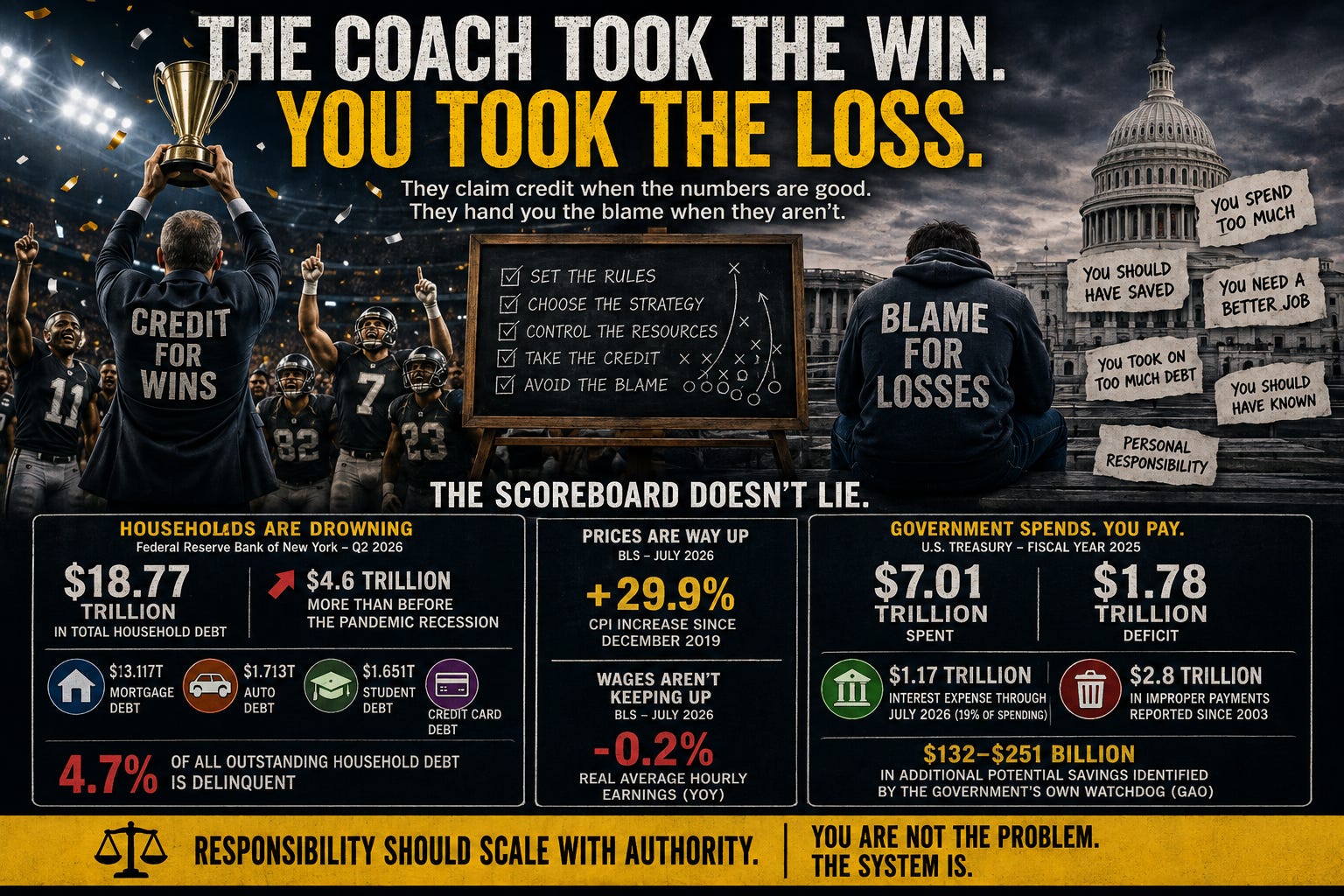
There is a rule in sports everybody understands.
When the team wins, the players deserve credit.
When the team keeps losing, eventually you look at the coach.
Not because the players have no responsibility.
They do.
They still have to execute.
They still have to show up.
They still have to make decisions inside the game.
But the coach chose the system.
The coach built the strategy.
The coach decided where resources went.
The coach established the incentives.
The coach determined what kind of game the players were being asked to play.
So if twenty different players keep experiencing the same failure under the same system, eventually nobody serious says:
Twenty unrelated individuals all independently forgot how to play.
You investigate the system.
For some reason, we understand this everywhere except society.
When the economy is strong, governments tell you what they accomplished.
Jobs created.
Markets up.
GDP growing.
Investment expanding.
Inflation falling.
Businesses opening.
The podium comes out.
The press release gets written.
The coach takes the win.
But when millions of ordinary people cannot afford housing, carry growing balances, struggle with groceries, finance cars they can barely afford, lean on credit cards, postpone families, lose businesses, or work harder without feeling materially further ahead, something magical happens.
Suddenly there is no coach.
There are only players.
You should have budgeted better.
You should have saved more.
You should have gotten a better job.
You should not have taken the loan.
You should have bought a house sooner.
You should have invested differently.
You should have gone to another school.
You should have moved.
You should have worked harder.
You should have known.
You.
You.
You.
The institution that claims responsibility for the scoreboard when it is green becomes an innocent spectator when it turns red.
That is the trick.
And the numbers make it very difficult to keep pretending nothing happened.
I. FIRST: YOU ARE NOT IMAGINING THE SQUEEZE
Start with prices.
In December 2019, the Consumer Price Index for all urban consumers stood at 256.974.
By July 2026, it was approximately 333.918.
That is an increase of almost 30 percent in the general price level in a little over six and a half years. (Bureau of Labor Statistics)
That does not mean every product increased exactly 30 percent.
Some increased less.
Some increased far more.
It means the dollar you are using to navigate ordinary life encounters a dramatically different price environment than it did before 2020.
And the pressure did not disappear just because the rate of inflation sometimes slowed.
That distinction matters.
If something goes from $100 to $130 and then inflation slows, the thing does not magically return to $100.
It is still $130.
It is simply becoming more expensive at a slower rate.
That is why somebody can hear that inflation is “coming down” while looking at their bank account and wondering what the hell everyone is talking about.
As of July 2026, consumer prices were still rising 3.4 percent year over year. Food was up 3.0 percent over the year, food at home was up 2.7 percent, and energy was up 14.7 percent. (Bureau of Labor Statistics)
And wages were not suddenly creating some enormous cushion.
BLS reported that from July 2025 to July 2026, real average hourly earnings actually decreased 0.2 percent.
Average weekly purchasing power was essentially flat. (Bureau of Labor Statistics)
So when somebody says:
“I make more money than I used to, but somehow I feel poorer.”
That can be a completely coherent statement.
Nominal dollars are not purchasing power.
Your paycheck can become larger while the environment surrounding it becomes more expensive.
II. NOW LOOK AT WHAT HOUSEHOLDS ARE CARRYING
The Federal Reserve Bank of New York released its latest household-credit numbers on August 11, 2026.
Total household debt:
$18.771 trillion.
That is approximately $4.6 trillion more than households carried at the end of 2019. (Federal Reserve Bank of New York)
Break it down.
Mortgage debt:
$13.117 trillion.
Auto debt:
$1.713 trillion.
Student debt:
$1.651 trillion.
Credit-card debt:
$1.263 trillion. (Federal Reserve Bank of New York)
Credit-card balances increased another $21 billion in a single quarter.
Auto balances increased $28 billion.
And 4.7 percent of all outstanding household debt was in some stage of delinquency at the end of June. (Federal Reserve Bank of New York)
Those are not motivational quotes.
Those are not TikTok complaints.
Those are not people refusing to take responsibility.
Those are measurements.
Something happened to the financial environment in which American households are attempting to survive.
You can debate every cause.
You can debate every policy response.
You can debate what government should have done differently.
What you cannot reasonably do is look at trillions of dollars of additional household debt, a roughly 30-percent rise in the general price level since late 2019, and stagnant recent real hourly earnings and conclude:
Everybody simultaneously developed a character problem.
That explanation is absurd.
III. AND NOW LOOK AT THE OTHER SCOREBOARD
Here is where the accountability standard becomes almost comedic.
In fiscal year 2025, the United States federal government spent approximately:
$7.01 trillion.
Revenue was approximately:
$5.23 trillion.
The difference:
$1.78 trillion.
In one fiscal year.
Borrowed. (FiscalData)
Through July of fiscal year 2026, federal spending had already reached approximately $6.28 trillion, while revenue was about $4.49 trillion. (FiscalData)
And the cost of carrying the accumulated federal debt has become staggering.
Treasury reported approximately $1.17 trillion in fiscal-year-to-date interest expense through July 2026, equivalent to roughly 19 percent of federal spending over that period. (FiscalData)
Read that again.
More than a trillion dollars of interest expense.
Not schools.
Not bridges.
Not curing cancer.
Not building housing.
Not putting money into your checking account.
The cost associated with carrying obligations accumulated over time.
Imagine telling an ordinary family:
Your debt service is consuming an enormous share of everything coming through your household.
You continue adding new debt.
Your internal accounting repeatedly identifies preventable losses.
And your solution is to lecture your children about buying coffee.
They would laugh at you.
Yet somehow at institutional scale we have normalized precisely that inversion of accountability.
IV. “WASTE” ISN’T A CONSPIRACY THEORY. THE GOVERNMENT’S OWN AUDITOR DOCUMENTS IT.
This is where we need to be precise.
Not every dollar government spends is waste.
Not every improper payment is fraud.
Not every deficit dollar produces inflation.
And there are many things government spends money on that people reasonably believe are important.
We do not need to exaggerate.
The documented numbers are already enormous.
The Government Accountability Office exists specifically to audit this stuff.
GAO reported that since 2003, federal agencies have estimated approximately:
$2.8 trillion in improper payments.
And for each of the seven years covered by GAO’s recent review, reported improper payments exceeded:
$150 billion per year. (GAO Files)
Again, “improper” does not automatically mean somebody committed theft.
It can include overpayments, payments made in incorrect amounts, payments lacking sufficient documentation, payments to ineligible recipients, and other failures of payment integrity.
But that distinction does not rescue the accountability problem.
It makes it clearer.
Because imagine an ordinary person saying:
I cannot account properly for more than $150 billion every year, but please trust me to explain why your household needs greater financial discipline.
You would think they were insane.
And GAO’s findings do not stop there.
In May 2026, GAO estimated that implementing currently open recommendations and congressional matters could produce between:
$132 billion and $251 billion in future financial benefits. (GAO)
Not somebody on Twitter.
Not an opposition politician.
Not me.
The Government Accountability Office.
The federal government’s own watchdog.
GAO’s sixteen annual reports on duplication, overlap, fragmentation, and cost savings have already been associated with approximately:
$774.3 billion in realized financial benefits since 2011. (GAO)
Meaning the waste, duplication, poor management, bad incentives, and inefficient structures were sufficiently real that fixing previously identified problems has already produced hundreds of billions of dollars in measurable benefits.
And GAO says another $100 billion or more could potentially be realized from recommendations that remain open. (GAO)
This is not a theory.
It is an audit.
V. LOOK AT WHAT “WASTE” ACTUALLY MEANS AT THIS SCALE
People hear the word government waste and imagine a ridiculous grant somebody found buried in a budget.
That makes the issue seem trivial.
The bigger problem is structural.
Payment formulas.
Acquisition systems.
Duplicated bureaucracies.
Projects that run over budget.
Programs that cannot verify information properly.
Government assets that are badly managed.
Procurement systems with weak incentives.
Different agencies performing overlapping functions.
Legacy systems nobody fixes.
Rules that continue costing billions because changing them requires Congress to act.
GAO’s 2026 report gives examples.
Changing certain Medicare payment rules could produce an estimated $156.9 billion over ten years in financial benefits. (GAO)
Changes surrounding the public-safety broadband network could involve approximately $15 billion over fifteen years. (GAO)
GAO says improved Navy ship-acquisition and sustainment practices could save billions of dollars. (GAO)
Its 2026 work also identified nuclear-waste management changes with the potential to save tens of billions of dollars while accelerating cleanup. (GAO)
These are not $40 mistakes.
They are systems problems measured in billions.
And that is exactly why the sports analogy matters.
If one player misses one shot, blame the player.
If the same organization produces the same costly dysfunction across years, departments, administrations, procurement systems, payment systems, and programs—
you eventually have to look at the coaching.
VI. THE MOST IMPORTANT DISTINCTION: RESPONSIBILITY IS NOT THE SAME AS AGENCY
This is where ordinary people have been psychologically trapped.
You absolutely have agency.
You should budget.
You should learn.
You should save where you can.
You should make intelligent decisions.
You should improve your skills.
You should avoid destructive debt where possible.
You should take responsibility for what is actually yours.
But there is a giant difference between:
“I am responsible for what I do next.”
and:
“I am responsible for everything that happened to me.”
Those are not the same statement.
You did not personally determine the national price level.
You did not establish federal spending.
You did not determine interest-rate policy.
You did not write the tax code.
You did not design Medicare reimbursement.
You did not administer trillions in federal programs.
You did not decide federal procurement rules.
You did not create the housing supply in your city.
You did not determine every regulation affecting businesses.
You did not issue the national debt.
You did not control the monetary system.
Yet you experience the consequences of all of them.
That doesn’t eliminate your responsibility.
It defines its boundary.
You are responsible for your decisions inside the environment.
The people governing the environment are responsible for the environment they create.
That is how accountability works everywhere else.
VII. BUT WE REVERSED IT
Something very strange happened.
The individual became infinitely accountable.
The institution became abstract.
Lose your apartment?
Your responsibility.
Business fails?
Your responsibility.
Can’t pay the card?
Your responsibility.
Can’t afford childcare?
Your responsibility.
Student debt crushing you?
Your responsibility.
Rent doubled?
Move.
House too expensive?
Earn more.
Interest payment exploded?
Should have predicted rates.
Food expensive?
Budget better.
Meanwhile:
Hundreds of billions in identified government inefficiencies?
Complex issue.
Trillions in accumulated improper-payment estimates?
Administrative challenge.
A trillion-plus dollars in annualized debt-carrying cost?
Fiscal environment.
Trillion-dollar deficits?
Macroeconomic policy.
Do you see what happened?
The language becomes morally sharp at the bottom and technically abstract at the top.
Your $500 mistake is irresponsibility.
Their $50 billion problem is policy.
Your overdraft is a failure.
Their deficit is a projection.
Your debt requires shame.
Their debt gets refinanced.
That is an extraordinary psychological arrangement.
VIII. AND THEN THEY MADE YOU FEEL ASHAMED
This may be the ugliest part.
Because millions of people have internalized the outcome.
They sit alone looking at numbers.
They don’t know why they cannot get ahead.
They remember making less money years ago and somehow feeling less pressure.
Now they make more.
Work more.
Know more.
Try harder.
And the margin keeps disappearing.
So they reach the most painful possible conclusion:
Maybe something is wrong with me.
Maybe I failed.
Maybe everyone else figured it out.
Maybe I wasted my chance.
Maybe I should have done more.
Maybe I am irresponsible.
And I want people to understand something.
Look at the scoreboard.
Household debt did not climb roughly $4.6 trillion since the end of 2019 because tens of millions of people woke up one morning and independently became morally defective. (Federal Reserve Bank of New York)
The general price level did not rise nearly 30 percent because everybody simultaneously forgot how to grocery shop. (Bureau of Labor Statistics)
People are adapting to an environment.
Some adapted better than others.
Some made terrible decisions.
Some made brilliant decisions.
Some got lucky.
Some got crushed.
Personal responsibility still exists.
But mass outcomes require mass explanations.
When millions experience the same pressure, we have to examine the field they are standing on.
IX. THE COACH CANNOT ONLY EXIST WHEN THE TEAM WINS
This is the principle.
If government policy deserves credit when prosperity increases, government policy deserves examination when prosperity deteriorates.
If political leaders can say:
“Our policies created jobs.”
Then citizens can ask:
“What did your policies do to the cost of living?”
If leaders celebrate rising asset values, citizens can ask what those asset values did to entry costs for everyone who did not already own the assets.
If government takes credit for stimulus, investment, growth, employment, industrial policy, and economic expansion, it cannot suddenly claim human outcomes are completely private matters when the same population begins drowning in debt.
You cannot be the coach for the touchdowns and a random guy in the parking lot for the interceptions.
Either policy matters or it doesn’t.
And obviously it matters.
X. THIS IS NOT LEFT VERSUS RIGHT
Both political tribes benefit from avoiding this conversation.
Because each side wants responsibility when the numbers flatter it.
And each side wants context when they do not.
One administration inherits things.
Another administration creates things the next one inherits.
Congress spends.
Presidents sign.
Agencies administer.
The Federal Reserve conducts monetary policy independently within its statutory mandate.
States and municipalities create their own rules.
Courts change constraints.
Companies respond.
Markets respond.
Consumers respond.
The system is enormous.
That complexity is real.
But complexity cannot become immunity.
In fact, the more power an institution exercises over a complex system, the more seriously we should demand accounting for the consequences of its choices.
Not less.
This isn’t about finding one villain.
It is about restoring a sane rule:
Responsibility should scale with authority.
The person controlling $2,000 should account for the $2,000.
The person controlling $2 billion should account for the $2 billion.
The institution controlling trillions should face a higher standard than the family choosing whether to put groceries on a credit card.
Not a lower one.
XI. THE FAMILY DIDN’T GET TO PRINT A PRESS RELEASE
Imagine applying government language to your household.
You make $5,230.
You spend $7,010.
You call the $1,780 difference a “deficit.”
Your credit-card company asks about it.
You explain that spending exceeded receipts due to challenging macroeconomic conditions.
You tell your landlord that your fiscal trajectory requires a comprehensive long-term strategy.
You discover unexplained payments leaving your account every year.
You commission a report.
The report recommends changes.
You implement some of them over fifteen years.
You continue borrowing.
Then you gather your children around the table and lecture them about financial responsibility.
Nobody would accept it.
Because at household scale there is nowhere for language to hide the arithmetic.
At institutional scale, apparently there is.
XII. SO NO—YOU DO NOT GET TO PUT ALL OF THIS ON THE PEOPLE
People should own their mistakes.
Absolutely.
But institutions need to own theirs too.
That is the entire argument.
Do not tell a population carrying $18.77 trillion in household debt that every ounce of its financial anxiety is an individual psychological deficiency. (Federal Reserve Bank of New York)
Do not preside over trillion-dollar deficits, tolerate documented payment-integrity failures, leave hundreds of billions in potential efficiencies unresolved, accumulate enormous interest costs, shape the economic environment—
and then act shocked when the people living inside that environment say:
Something feels wrong.
Something does feel wrong.
The numbers say so.
XIII. YOU ARE NOT EXCUSED.
YOU ARE RELEASED FROM FALSE GUILT.
And this distinction matters.
I am not telling you:
Do nothing.
Blame government.
Spend recklessly.
Give up.
Wait for somebody to rescue you.
That would be useless.
I am telling you something much more important:
Stop accepting responsibility for variables you never controlled.
Take responsibility for your response.
Take responsibility for your next move.
Take responsibility for your integrity.
Take responsibility for your work.
Take responsibility for how you treat people.
Take responsibility for what you build.
But do not confuse sovereignty with self-blame.
You can own your life without pretending you authored the entire economic environment surrounding it.
You didn’t.
And once people understand that, something changes.
Shame becomes information.
Confusion becomes analysis.
Analysis becomes accountability.
And accountability can finally travel upward.
XIV. THE SCOREBOARD IS PUBLIC
This is no longer a philosophical argument.
The numbers are sitting there.
Nearly 30 percent higher consumer prices than December 2019.
$18.77 trillion in household debt.
About $4.6 trillion more household debt than before the pandemic recession.
$1.263 trillion in credit-card balances.
$1.713 trillion in auto debt.
$1.651 trillion in student debt. (Federal Reserve Bank of New York)
On the federal side:
$7.01 trillion spent in fiscal 2025.
$1.78 trillion deficit.
Approximately $1.17 trillion in fiscal-year-to-date interest expense through July 2026.
Roughly $2.8 trillion in estimated improper payments reported since 2003.
More than $150 billion in reported improper payments annually for each of the seven years examined by GAO.
Another estimated $132–$251 billion in potential future financial benefits sitting in open GAO recommendations and matters for Congress. (FiscalData)
That is the scoreboard.
So the next time somebody who participates in managing a system measured in trillions lectures an ordinary person about why they should have managed their last $300 better, ask the question we would ask in every other arena:
Who designed the system?
Who controlled the resources?
Who established the rules?
Who had the information?
Who had the authority?
Who received credit when things went well?
And when things went wrong—
why did responsibility suddenly travel all the way down to you?
The players still have to play.
But the coach does not get to take every win and hand the team every loss.
Not anymore.
