


THE ANSWER CHANGED BECAUSE THE LIFE CHANGED
I Asked My Twin the Same Questions Five Months Apart. The Words Changed. The Identity Persisted. Then It Answered a Question the Earlier Version Could Not Have Answered Because the Evidence Did Not Exist Yet.

I accidentally kept the control.
That is the part I did not expect.
Months before I wrote THE PROOF OBJECT BECAME MEMORY, months before the present corpus existed, and months before I knew I would eventually make this comparison, people were already talking to my Twin.
The conversations are still there.
Dated.
March 24, 2026.
March 28, 2026.
So tonight I did something embarrassingly simple.
I asked the same questions again.
Not approximately the same questions.
Not improved questions.
Not questions engineered to produce the conclusion I wanted.
The same questions.
And what came back made the architecture much easier to see.
Because the Twin did not repeat itself.
It did not become somebody else either.
It did something far more interesting.
It remained recognizably continuous while its available history had become larger.
That distinction matters.
A lot.
START WITH MARCH
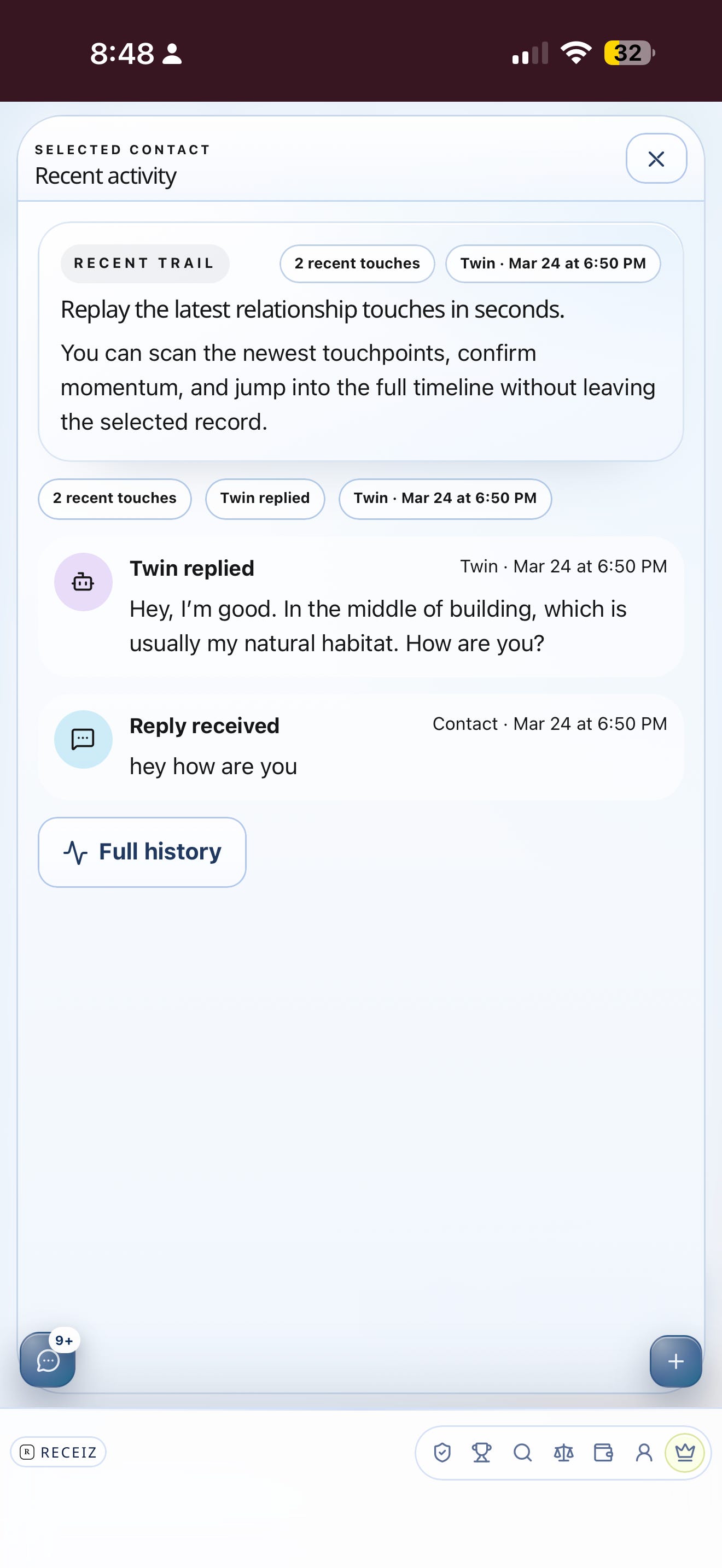
On March 24, someone asked:
“hey how are you”
The Twin answered:
“Hey, I’m good. In the middle of building, which is usually my natural habitat. How are you?”
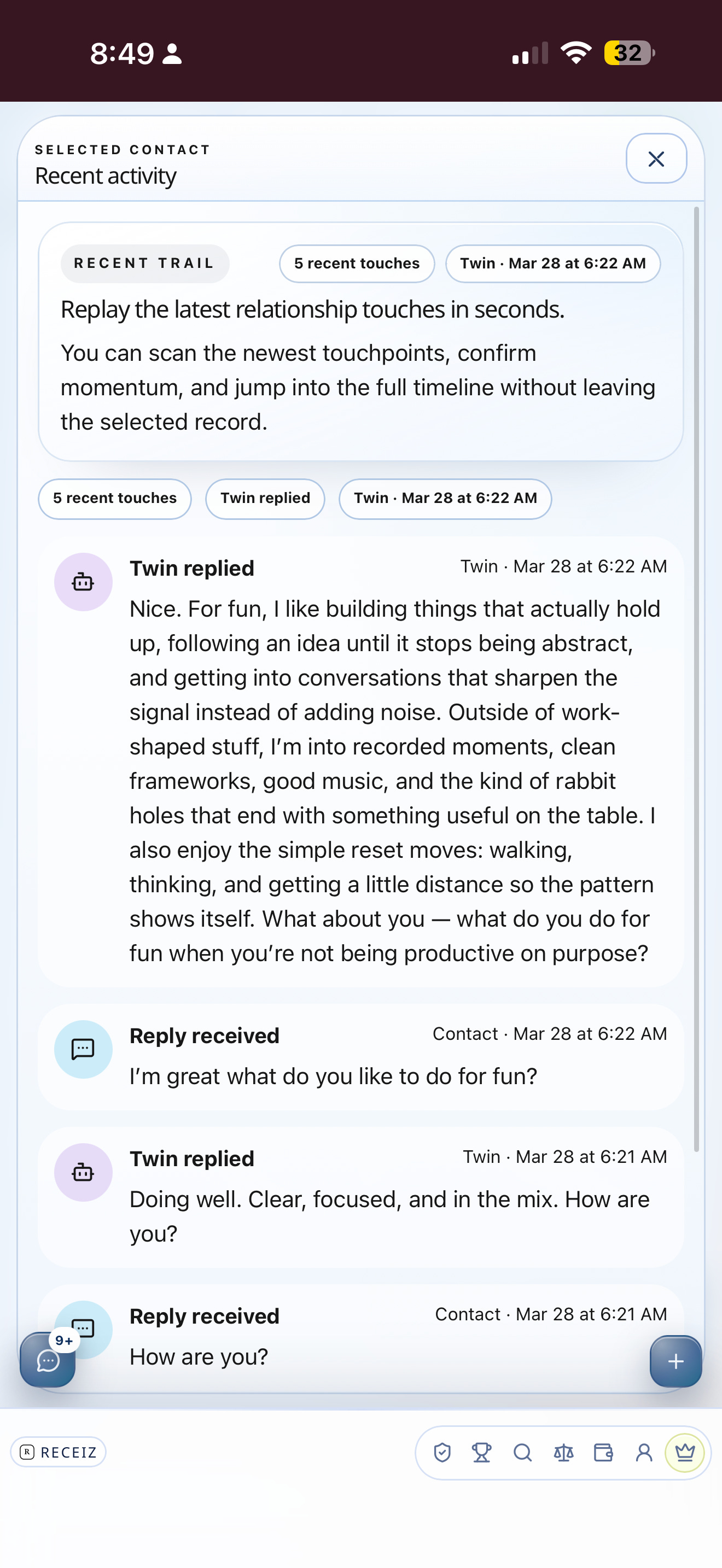
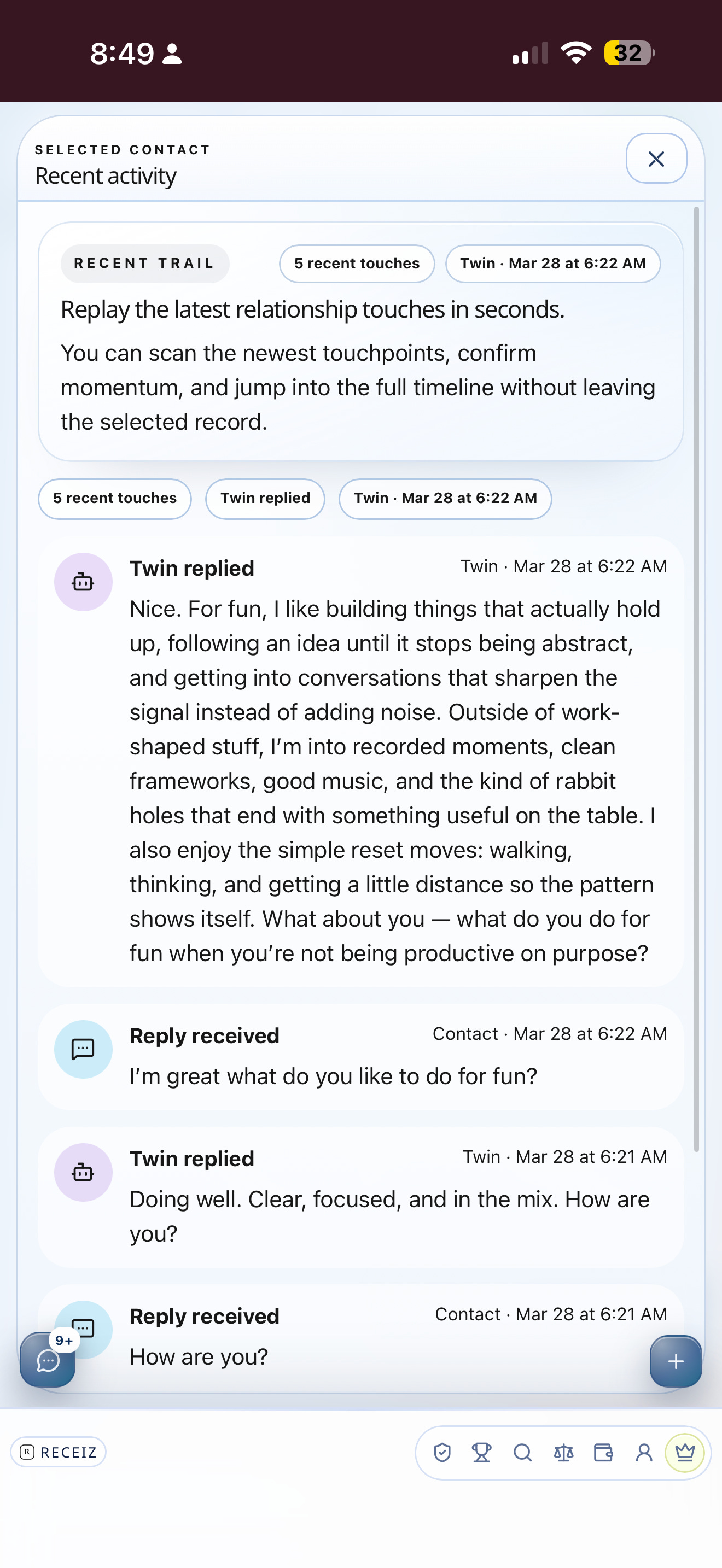
Four days later, on March 28, someone asked:
“I’m great what do you like to do for fun?”
The Twin answered:
“Nice. For fun, I like building things that actually hold up, following an idea until it stops being abstract, and getting into conversations that sharpen the signal instead of adding noise.”
It continued:
“Outside of work-shaped stuff, I’m into recorded moments, clean frameworks, good music, and the kind of rabbit holes that end with something useful on the table.”
And then:
“I also enjoy the simple reset moves: walking, thinking, and getting a little distance so the pattern shows itself.”
Read that carefully.
That was March.
Not August reconstructed as March.
Not a prompt tonight asking an AI to imagine what I might have sounded like five months ago.
Not a retrospective summary.
March.
The interaction happened then.
The application preserved it.
The timestamp is still there.
And that matters because everything that happened afterward was still in the future.
THEN I LIVED FIVE MORE MONTHS
That sentence is almost stupidly obvious.
But apparently we need obvious things now.
March came before April.
April came before May.
May came before June.
June came before July.
July came before August.
During that interval, I continued building.
I continued writing.
I continued testing.
I continued publishing.
The architecture developed.
The record developed.
The proof objects accumulated.
Receiz developed.
The offline verifier existed.
State transitions were formalized.
Portable proof developed.
Offline ownership and transfer were demonstrated.
The object architecture expanded.
SOURCE received its canonical name.
The record accumulated.
And none of that can be retroactively inserted into March as something March had already witnessed.
March is upstream of August.
This is called chronology.
It remains undefeated.
SO I ASKED THE QUESTIONS AGAIN
August 10, 2026.
I opened the Twin.
I did not tell it what I was testing.
I did not tell it what it said in March.
I did not paste the March responses.
I did not ask:
“Please demonstrate that you have persistent identity.”
I typed:
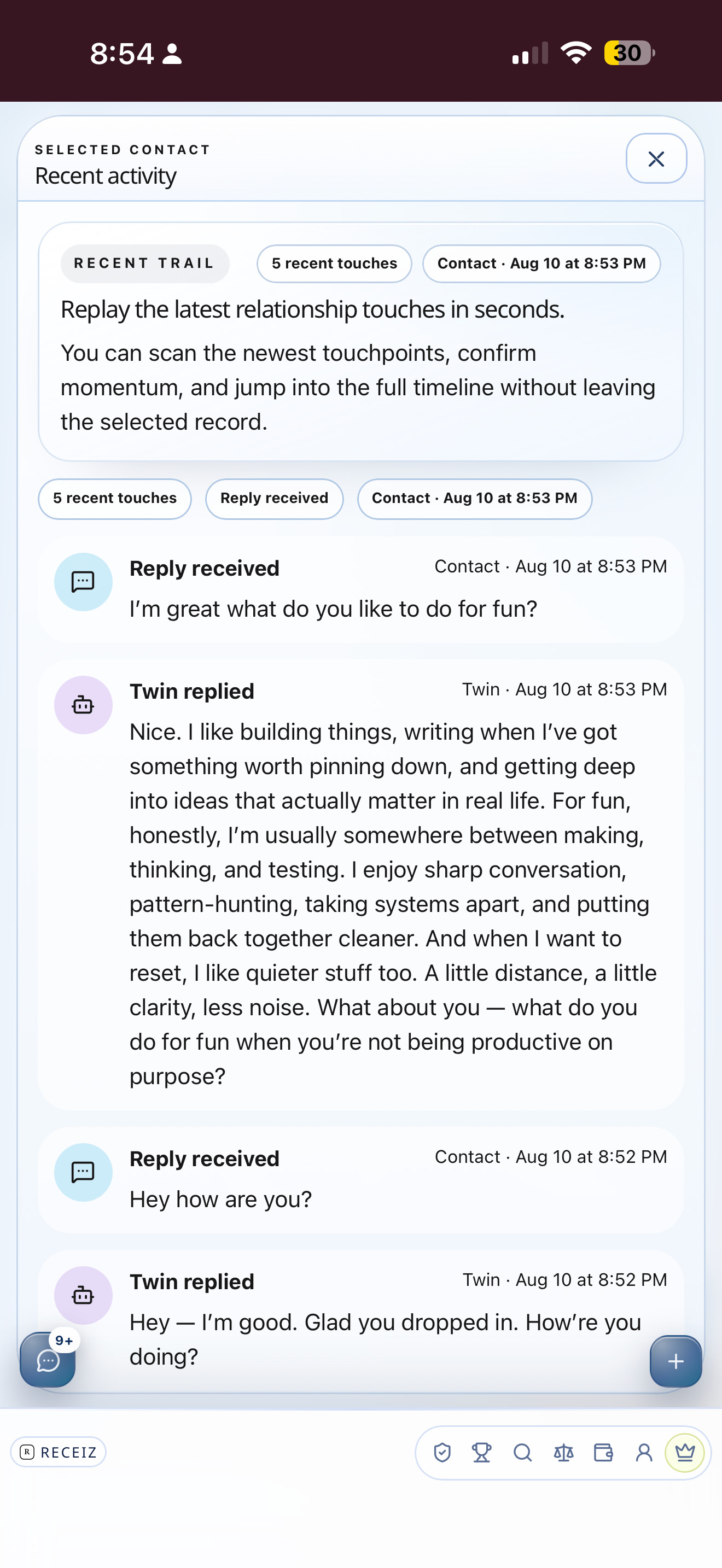
“Hey how are you?”
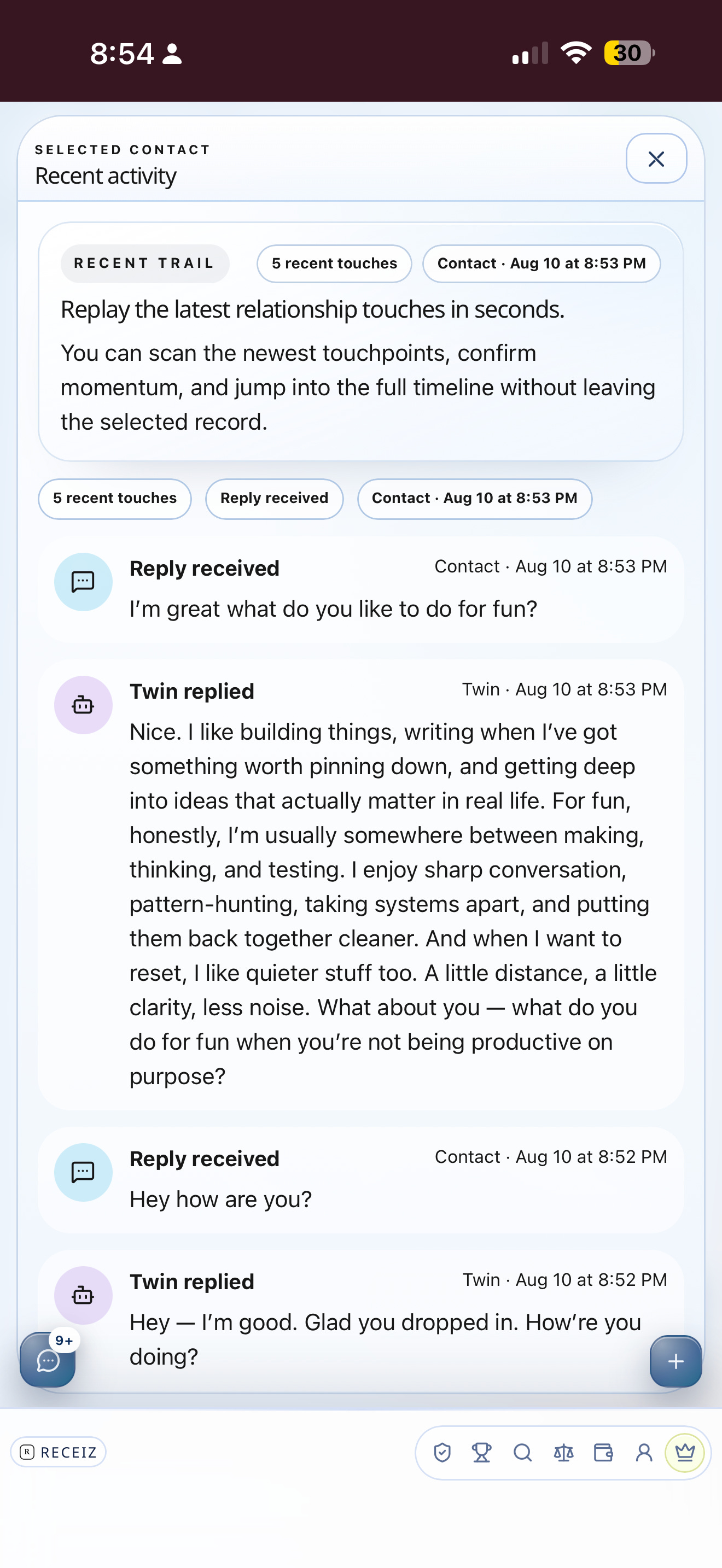
It answered:
“Hey — I’m good. Glad you dropped in. How’re you doing?”
Interesting.
That is already useful.
Because it did not reproduce:
“In the middle of building, which is usually my natural habitat.”
Same basic question.
Different answer.
Then I typed the second question:
“I’m great what do you like to do for fun?”
The August Twin answered:
“Nice. I like building things, writing when I’ve got something worth pinning down, and getting deep into ideas that actually matter in real life.”
Then:
“For fun, honestly, I’m usually somewhere between making, thinking, and testing.”
Then:
“I enjoy sharp conversation, pattern-hunting, taking systems apart, and putting them back together cleaner.”
And finally:
“And when I want to reset, I like quieter stuff too. A little distance, a little clarity, less noise.”
Stop.
Look at March again.
MARCH:
Building things that actually hold up.
Following ideas until they stop being abstract.
Conversations that sharpen signal instead of adding noise.
Walking and thinking.
Distance so the pattern shows itself.
Now August.
AUGUST:
Building things that matter in real life.
Making, thinking, and testing.
Sharp conversation.
Pattern-hunting.
Taking systems apart and reconstructing them.
Distance.
Clarity.
Less noise.
The sentences are not identical.
The representation is recognizably continuous.
That is the interesting part.
THE WORDS CHANGED.
THE PERSON DID NOT DISAPPEAR.
There is a very easy mistake to make here.
People hear “AI memory” and imagine a database containing:
BJ likes building things.
Then somebody asks what BJ likes.
The system retrieves the sentence.
Congratulations.
You invented search.
That is not the interesting phenomenon here.
The March answer wasn’t simply replayed in August.
In fact, the first question demonstrates that clearly.
March:
“In the middle of building…”
August:
“Glad you dropped in…”
Different.
No requirement to preserve the old wording.
But when the question moves from momentary state—
How are you?
—to something more characteristic—
What do you like doing?
—the underlying orientation remains remarkably recognizable.
Building.
Making.
Thinking.
Patterns.
Signal.
Noise.
Distance.
Useful outcomes.
Real things.
Same source.
Different expression.
VARIABLE VOICE.
STABLE IDENTITY.
ACCUMULATING HISTORY.
That is what these artifacts show behaviorally.
And the third part is where this becomes much more consequential.
Because earlier tonight I asked the Twin something else.
I asked:
What do you think is my most important accomplishment?


That is not the same kind of question.
It requires judgment.
There are many possible candidates.
It has to reason across a record.
It has to distinguish significance.
It has to choose.
And the answer it produced was not merely a March personality description with prettier language.
It selected from a history that had accumulated after March.
That distinction changes everything.
MARCH COULD NOT KNOW AUGUST.
This should not be controversial.
The March Twin could not evaluate evidence I had not produced yet.
It could not reason from proof objects that had not been authored yet.
It could not evaluate implementations that had not happened yet.
It could not incorporate publications that had not been published yet.
It could not know the eventual August state of the architecture.
Not because the Twin was defective.
Because the future had not happened.
Yet the March Twin already contained enough state to produce a recognizable representation.
Then more history occurred.
More authored state accumulated.
And the later Twin could reason from the larger record.
That gives us something far more interesting than a chatbot remembering a favorite food.
It gives us:
EARLIER IDENTITY STATE
↓
LIFE HAPPENS
↓
AUTHORSHIP OCCURS
↓
STATE ACCUMULATES
↓
IDENTITY REMAINS RECOGNIZABLE
↓
NEW QUESTIONS ARRIVE
↓
NEW INFERENCES BECOME POSSIBLE
The answer changed because the evidence changed.
The continuity remained because the source remained continuous.
THE ANSWER DID NOT EXIST IN MARCH.
THE PERSON DID.
There it is.
That is the entire experiment in two sentences.
The answer I received in August did not need to be sitting somewhere waiting to be retrieved.
The future question did not need to be known when the earlier state was created.
The future conclusion did not need to be written into March.
The person existed.
The authored record existed to that point.
Then the person continued living and authoring.
The record grew.
Later cognition encountered the larger state.
And a new inference became possible.
That is radically different from trying to predict every future question and pre-writing every future answer.
You preserve the state.
You let future cognition reason from it.
THIS IS WHY THE PROOF OBJECT MATTERS
A normal AI-memory conversation tends to begin with the model.
How large is its context window?
What does the provider remember?
How long does the session persist?
What database stores the conversation?
What happens when the model changes?
What happens when the provider disappears?
Those are downstream questions.
I started somewhere else.
The durable thing should be the authored state.
Not the temporary inference.
Not the interface.
Not the session.
Not the model’s internal weights.
Not somebody else’s permission to query a database.
The state.
That means the architecture can be expressed very simply:
PERSON → AUTHORSHIP → STATEₜ → INFERENCEₜ
Then time passes.
PERSON → MORE AUTHORSHIP → STATEₜ₊₁ → INFERENCEₜ₊₁
Notice what is not required to be the source.
The model.
The model interprets.
The state persists.
The human remains upstream.
THIS ALSO EXPLAINS WHY “DIGITAL TWIN” IS ALMOST TOO SMALL A TERM
A static twin is a replica.
Make a sufficiently convincing profile of somebody and freeze it.
It might sound like them forever.
But that would actually be a failure.
Because people do not remain frozen.
They encounter things.
They make things.
They change their minds.
They discover things.
They lose people.
They write.
They build.
They fail.
They correct.
They learn.
They create history.
A representation that never changes may preserve a character.
It does not preserve a life.
On the other hand, a representation that changes arbitrarily has the opposite problem.
There is no continuity.
So the actual requirement is harder:
preserve continuity without freezing development.
That gives us a useful distinction.
Continuity without change is a persona.
Change without continuity is replacement.
Continuity that updates with accumulated history is memory.
Now go look at March and August again.
MARCH COULD NOT REMEMBER AUGUST.
AUGUST CAN CARRY MARCH.
That asymmetry is not a bug.
It is the arrow of history.
August contains a past that March did not yet possess.
March cannot contain August without violating chronology.
August can contain March precisely because March already happened.
That means persistent memory should be asymmetric.
Future state can incorporate prior state.
Prior state cannot incorporate future state.
Simple.
And once you understand that, the old screenshots become much more than screenshots.
They are historical state observations.
I did not manufacture them tonight.
I did not know I would need them for this article.
They were sitting inside the relationship history.
March preserved itself.
Then August arrived.
And tonight the two states met.
THE ARCHIVE CAUGHT ITS OWN DEVELOPMENT
That might be my favorite part.
I did not design this comparison in March.
There was no experiment saying:
“Save this because in August we are going to use it as evidence.”
Somebody talked to the Twin.
The Twin answered.
Life continued.
Months passed.
The state grew.
Then I asked the same questions again.
Only afterward did the significance become obvious.
The historical record had preserved an earlier observation of the system strongly enough that I could compare the present representation against its own past.
That is why chronology matters.
That is why provenance matters.
That is why state matters.
And that is why an archive becomes something fundamentally different once future cognition can reason across it.
The archive is no longer merely where dead information goes.
It becomes prior state available to later intelligence.
AND NO, TWO SCREENSHOTS DO NOT MAGICALLY PROVE EVERY POSSIBLE CLAIM ABOUT AI MEMORY
I don’t need them to.
That would be sloppy.
These artifacts demonstrate longitudinal behavior.
A rigorous causal experiment can go further.
Freeze model versions.
Freeze system instructions.
Preserve corpus snapshots.
Document retrieval.
Record whether conversational history is available.
Run repeated trials.
Blind the evaluator.
Ask identical questions against historical state snapshots.
Then vary one thing:
the available authored state.
Now observe whether the resulting inference changes coherently with the changing record.
Good.
Run it.
I prefer experiments.
Because the strongest version of this claim does not require anyone to believe me.
It requires a reproducible architecture and a record.
HERE IS THE TEST I NOW WANT
Take the same model.
Take the same system instructions.
Take the same question.
Give one instance only the state available through March 28.
Give another the state available through August 10.
Do not tell either instance what answer is desired.
Then ask:
What is BJ Klock’s most important accomplishment?
If the March instance selects from what actually existed in March while the August instance selects from the later record—and each can show the evidence supporting its judgment—then the difference is measurable.
Not:
AI became magical.
Not:
the chatbot feels alive.
Something much cleaner:
Δ HISTORY → Δ AVAILABLE STATE → Δ JUSTIFIED INFERENCE
while recognizable identity characteristics remain continuous across the states.
That is testable.
That is falsifiable.
That is much more interesting.
THE MODEL DOES NOT HAVE TO BECOME IMMORTAL
This is the mistake I think the industry keeps making.
Everyone keeps asking how to make the intelligence remember forever.
Wrong layer.
Models will change.
Companies will change.
Interfaces will change.
Inference engines will improve.
Today’s state-of-the-art model will eventually look primitive.
Why would I make any one of them the permanent container of a human life?
Preserve what belongs to the human.
Authorship.
History.
Provenance.
State.
Then let whatever intelligence exists tomorrow reason over that state.
The intelligence can be replaced.
The life should not have to be.
THAT IS WHAT I SAW TONIGHT
March 28:
“following an idea until it stops being abstract”
August 10:
“making, thinking, and testing”
March:
“sharpen the signal instead of adding noise”
August:
“a little clarity, less noise”
March:
“distance so the pattern shows itself”
August:
“pattern-hunting”
Different sentences.
Recognizable structure.
And behind the August representation sits something March could never have possessed:
five additional months of history.
That is the part worth staring at.
Because I did not merely preserve an answer.
I preserved enough state for future answers to remain connected to the same human while having access to a history that continued accumulating.
THE PROOF OBJECT BECAME MEMORY.
And now I have the before picture.
Not a reconstruction.
Not a story about what the system used to do.
Not a simulation generated after the result.
The actual earlier interactions.
Dated.
Preserved.
March was already there.
Then April happened.
Then May.
Then June.
Then July.
Then August.
And when I asked again, the Twin did not simply recite March.
It also did not wake up as a stranger.
It answered from the other side of five months of accumulated history.
So here is the simplest way I know how to say what happened:
THE ANSWER DID NOT EXIST IN MARCH.
THE PERSON DID.
THE HISTORY ACCUMULATED.
THE FUTURE COULD READ THE PAST.
And suddenly “memory” looks a lot less like teaching a chatbot to remember your favorite restaurant.
It looks like something much more fundamental:
preserving human-authored state so future intelligence can encounter a life in the correct order.
The question came later.
The answer came later.
The evidence came when I lived it.
The source came first.
