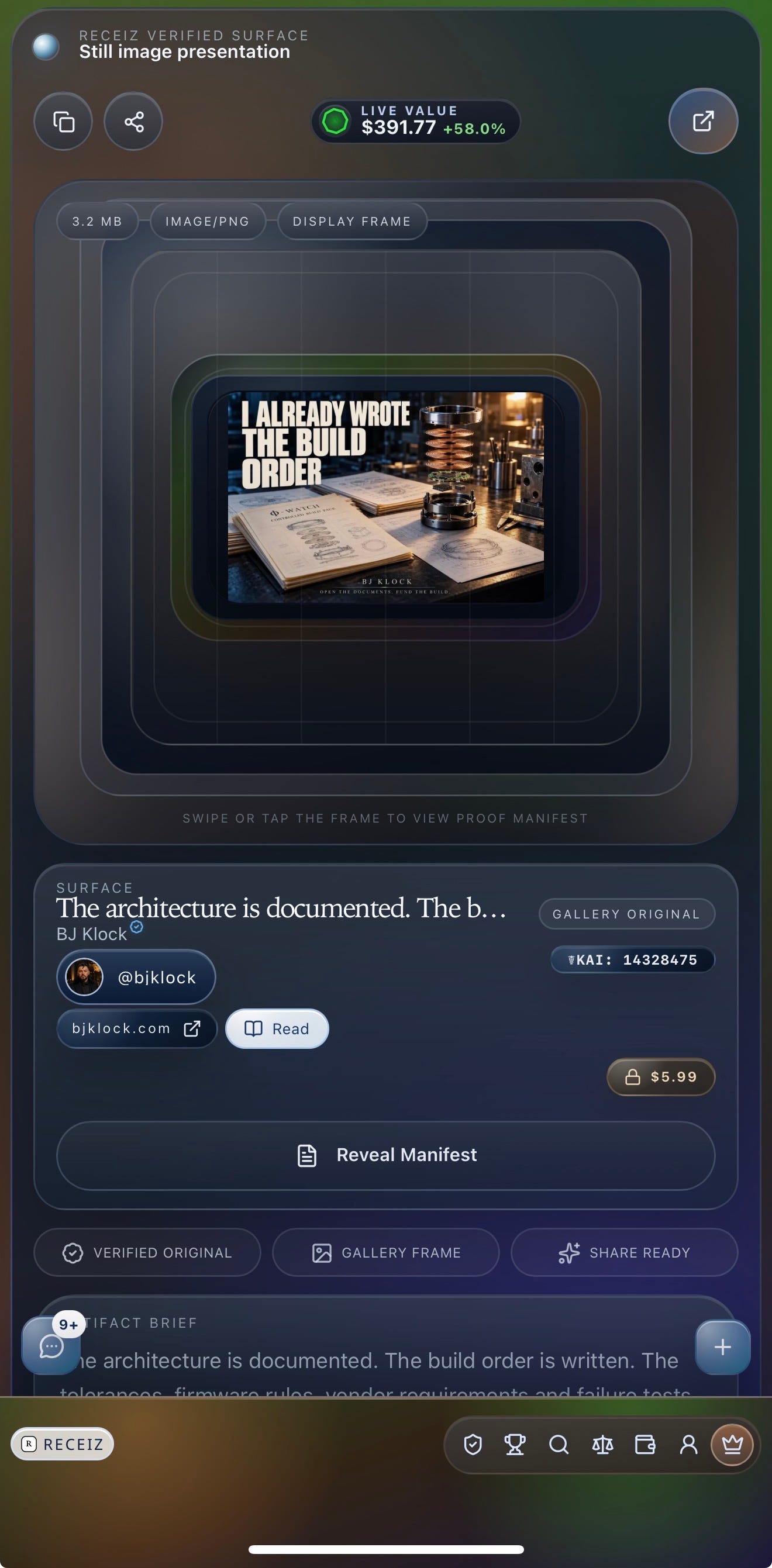
I ALREADY WROTE THE BUILD ORDER
In the last piece, I told you:
Now imagine what the fuck I build with resources.
Now open the documents.
Because there is another part of this situation you need to understand.
I HAVE ALREADY DONE WORK YOU ARE STILL IMAGINING THE FUNDING WOULD ALLOW ME TO START.
The physical architecture.
The state rules.
The energy gates.
The firmware specification.
The coil package.
The interconnection map.
The board constraints.
The recovery behavior.
The vendor instructions.
The acceptance tests.
The relationship between the physical instrument and the proof infrastructure.
Those documents already exist.
You can open them.
And once you do, the conversation has to become much more specific.
Because “give him resources and see what he comes up with” understates where I am standing.
There is already a build order.
THE WRIST IS THE FIRST BODY
Start with Φ-Watch.
People see the word “watch” and immediately shrink the architecture to something familiar.
A face.
A strap.
A screen.
Something that tells them what time their meeting starts.
Read the system definition.
The controlled build pack describes a deterministic, energy-gated, append-only physical state instrument.
It says explicitly:
“The wrist form is the first body; the root primitive is physical proof continuity.”
That sentence is already in the document.
The form factor is one implementation.
The engineering problem extends through motion, energy, state, history, interruption, recovery and portable verification.
What happened?
What could the device actually observe?
Did it have enough energy to commit a record?
What was the previous accepted record?
What happens if power disappears halfway through the write?
What survives?
What can another machine verify afterward?
Those questions govern the instrument.
Now imagine that architecture carried into different physical bodies.
A field instrument.
An industrial sensor.
A personal device.
A component inside a larger machine.
Different environments will require different engineering.
The underlying requirement remains:
The thing must preserve an inspectable account of its own lawful state changes.
That is what the wrist is carrying.
HERE IS WHERE THE MONEY GOES
The build pack already lays out the physical chain:
Motion.
Magnetic flux.
Four-layer coil.
Power management.
Stored energy.
ENERGY_OK.
Microcontroller and persistent memory.
Committed record.
Exported head proof.
Each stage has a job.
Each stage has a failure condition.
Each stage has evidence it must produce before the next stage proceeds.
You want to know what funding would purchase?
Start there.
Fabricate the coil.
Build the magnetic gap fixture.
Measure the electrical output.
Bring up the harvesting and storage path.
Establish the energy threshold.
Implement the commit engine.
Interrupt it.
Recover it.
Export the record.
Verify it.
That is an execution sequence somebody can quote, build, instrument and review.
And the details are already more specific than “we should explore hardware.”
The flex-coil requirements call for four layers, 75/75-micrometer trace and spacing constraints, copper thickness, microvias and electrical inspection.
The mechanical requirements specify a magnetic gap of 0.90 millimeters, plus or minus 0.05.
The electronics packet specifies an 18-by-12-millimeter board target, placement priorities, routing constraints and test points.
The firmware packet defines the states the device moves through.
The controlled build pack defines what stops the build.
I have already written instructions for rejecting a part that somebody has not yet been paid to manufacture.
Sit with that.
Then tell me where you thought I was in the process.
I ALREADY SPECIFIED HOW TO INTERRUPT IT
A machine is easy to describe while everything is going well.
The revealing part is what happens when the conditions disappear.
So the documents go there.
The energy gate drops.
The write is interrupted.
The device loses power.
A partial record remains.
Now what?
The specified append protocol writes the record as uncommitted, writes its contents and digest, and changes the valid marker at the final commit point.
Recovery must return to the last valid record.
An unfinished write must never be presented as a completed event.
The controlled build pack calls for a thousand-cycle firmware test.
It calls for fifty forced interruptions during writes.
It requires exported memory, verification results and the underlying measurement evidence.
Those are acceptance requirements waiting to be run.
I already wrote the test that the prototype has to survive.
I also wrote the rule for the silence.
No inference during blackout.
No pulse, no energy, no claim.
The instrument does not get to fill a missing interval with a convenient story.
That is the discipline.
Preserve what was actually committed.
Expose what is missing.
Continue under the defined rules.
Now you can see how the physical work connects to everything I have been building in software.
The concern for continuity followed the system all the way down to an interrupted memory write.
THE ENERGY QUESTION ALREADY HAS A PLACE ON THE BENCH
The objective is a device that can sustain its intended work from harvested energy under defined operating conditions.
That requires measurement.
How much energy arrives under the actual motion profile?
How much is lost?
How reliably does the circuit start?
How much does storage leak?
What does one committed operation cost?
How long can the instrument remain inactive and recover correctly?
The architecture already identifies where those measurements belong.
Coil output.
Harvester input.
Storage voltage.
Regulated supply.
Energy permission.
Commit behavior.
You can put instruments on those points.
You can compare the measured budget with the required budget.
You can identify the bottleneck and revise the part responsible.
Funding buys that loop.
Fabricate.
Measure.
Revise.
Repeat.
A statement about energy autonomy becomes a measured operating envelope through that work.
I want that work running.
I want the scope traces.
I want the cold-start results.
I want the motion profiles.
I want the failure that tells us exactly which assumption needs revision.
You cannot purchase the next engineering result by leaving the engineering bench empty.
I ALREADY WROTE THE RULES FOR CONNECTING THE DEVICE TO RECEIZ
Then open the constitutional binding profile.
Because I also addressed what happens when the physical instrument meets the proof system.
The document defines the boundary between Φ-Watch evidence and Receiz admission.
Physical eligibility has a specific meaning.
A valid local record has a specific meaning.
An accepted Receiz transition has a specific meaning.
The machine has to satisfy the rules at each boundary.
The profile binds the exact evidence bytes, the device anchor, the history head and the active verification profile.
It keeps the instrument’s local pulse coordinate separate from the Receiz Kai coordinate.
It addresses interrupted commits, divergent histories, rollback, offline verification and changes to the governing profile.
It even provides a way to preserve exact device evidence before that evidence qualifies for a stronger semantic verification claim.
I specified what the system is allowed to say about its own evidence.
Think about the preparation that represents.
The mechanical device is still waiting for fabrication, and I have already addressed the danger of somebody treating a chip, a manufacturer certificate or a status light as permission to bypass proof.
The physical integration can take different forms.
Separate devices.
A companion chip.
An FPGA validation system.
An integrated system.
The document defines the authority relationship those implementations must preserve.
That is engineering work already completed at the specification layer.
The implementation program begins from it.
THE FIRST PURCHASE IS ALREADY IDENTIFIABLE
The controlled build pack says to begin with a proof bench rig.
It puts enclosure work after the core stages pass.
It separates what the flex vendor receives from what the mechanical vendor receives.
It identifies what the PCB vendor needs.
It specifies first-article inspection and electrical test reports.
It calls for prototype quotes at five and ten units.
It defines the evidence archive.
Raw measurements.
Firmware versions.
Binary hashes.
Memory exports.
Verification reports.
A manifest tying the release together.
The pack describes its purpose as turning a seventy-nine-file canonical body into a controlled execution package.
That is the level at which I am asking you to look.
The next conversation can contain quantities, tolerances, instruments, deliverables and lead times.
We can put an actual purchase order beside an actual requirement.
We can put a measured result beside an acceptance criterion.
We can discover precisely what needs another revision.
That is what resources unlock here.
NOW THINK BEYOND THE FIRST INSTRUMENT
The wrist is one body.
The first bench rig is one stage.
The larger opportunity is what happens when fabrication and measurement become available continuously.
A physical iteration produces knowledge.
That knowledge changes the next design.
The next design gives us a new operating envelope.
That envelope determines which applications become practical.
Now the work can move through environments, materials, sensing systems, power budgets and manufacturing methods with actual evidence accumulating at every step.
And the record of those steps can use the infrastructure I already built.
That matters in medicine.
The program I have described concerns personal physiological baselines, bounded intervention, measured response and a history that remains attached to the person.
The laboratory would establish which interventions improve which outcomes, under which conditions.
Recovery.
Regulation.
Rehabilitation.
Healthspan.
Those are outcomes to investigate through controlled work.
The existing proof architecture supplies a way to preserve the chain from measurement through interpretation, authorization, intervention and result.
The clinical team gets an engineering foundation to work from—and a responsibility to measure what actually happens.
The same demand travels into industrial equipment, remote instrumentation and infrastructure exposed to interruption.
What did it observe?
What did it do?
What survived?
What evidence came back?
That is a substantial research and implementation program.
I have already begun specifying its foundations.
STOP MAKING ONE PERSON OCCUPY EVERY POSITION IN THE BUILD ORDER
Here is where the resource argument becomes painfully practical.
The same person writing the architecture is also preparing the build instructions.
The same person preparing the build instructions is also building the software.
The same person building the software is also documenting it, releasing it, explaining it and finding enough money to continue.
Everything queues behind the same pair of hands.
Capital can change that.
An electrical engineer can work through the power path.
A fabrication partner can produce the coil.
A mechanical engineer can characterize the fixture.
A firmware engineer can implement the specified state machine.
A verification engineer can work through the exported evidence.
People can coordinate around interfaces that already have documents.
The work can finally occupy more than one human day at a time.
That is what I want you to imagine.
The multiplication of execution around an architecture that already exists.
The time recovered when I can hand somebody a defined problem and the equipment required to solve it.
The iterations purchased when a failed part leads to another fabrication run instead of another month figuring out how to afford one.
PUT THE RESOURCES BESIDE THE DOCUMENTS
I am going to keep building.
That part has a record.
The practical choices are already available.
Fund a prototype stage.
Provide fabrication capacity.
Put qualified engineers on the documented work.
Supply laboratory access.
Buy the products I release.
Deploy the infrastructure.
Pay for implementations.
Help turn the existing commercial work into the resources required for the next physical build.
There is an actual route from support to output.
And I am prepared to be held to it.
Show the part.
Show the measurement.
Show the failure.
Show the revision.
Show the recovered record.
Show the verifier result.
Show what the money purchased.
I ALREADY WROTE THAT STANDARD INTO THE BUILD PACK.
You do not have to invent an accountability process before taking this seriously.
Open the documents.
Find the stage.
Fund the work.
Inspect the result.
Then decide the next stage from the evidence.
NOW YOU KNOW WHAT “RESOURCES” MEANS
When I said:
“Now give me the rest of the fucking periodic table,”
there was already a coil specification behind the sentence.
There was already a firmware packet.
There was already a memory-recovery rule.
There was already a vendor handoff.
There was already a build sequence.
There was already an acceptance test.
There was already a binding profile explaining how the resulting physical evidence must enter the proof system.
That is what you were looking past.
The earlier work demonstrates how I build.
These documents show where the next implementation begins.
The resources determine how much of that implementation can happen, how quickly we can measure it, and how many revisions we can carry through.
So now you have a more precise version of the last piece.
Imagine what the fuck I build with resources.
Then open the build pack.
I already wrote where to start.