NOTICE OF PRESERVATION, DEMAND FOR VERIFIED RESPONSE, AND PUBLIC MARKET-INTEGRITY NOTICE

Concerning Auction Integrity, Comp Formation, Celebrity Promotion, Creator Compensation, Vault Custody, Slab Authentication, High-End Card Index Valuation, Market Concentration, and Collector Protection
Date: July 4, 2026
Response Deadline: July 13, 2026, at 5:00 p.m. Eastern Time
To:
Michael Rubin
Fanatics Holdings, Inc.
Fanatics, Inc.
Fanatics Collectibles
Topps
Fanatics Collect
Fanatics Live
Fanatics Vault / PWCC-era vault and marketplace systems
All related trading-card, auction, marketplace, live-commerce, vaulting, creator, affiliate, and collectibles entities
Legal Department / General Counsel
Additional Notice Parties, As Applicable:
Secure Collectibles
WonderShyne Index
Kevin O’Leary
Matt Allen / Shyne150
Paul Warshaw
Any affiliated entities, promotional partners, auction partners, valuation partners, vaulting partners, authentication partners, grading partners, media partners, creator partners, celebrity promoters, or related persons/entities participating in, promoting, advising, valuing, authenticating, vaulting, syndicating, financing, displaying, or presenting high-value sports-card portfolios.
From:
BJ K℞ Klock, Φ.K.
Kai-Rex Klok ☤ K℞K
PHI Kappa of the Unified Field
Receiz.com/bjklock
☤ K℞K Φ.K.
Re: Demand for Verified Response Concerning Auction Integrity, Shill-Bidding Controls, Creator Compensation, Comp Formation, Vault Custody, High-End Index Valuation, Market Concentration, and Collector Protection
This is a formal notice of preservation, demand for verified response, and public market-integrity notice concerning the sports-collectibles market.
This notice concerns Fanatics’ role in the sports-collectibles market, including licensed trading cards, collectibles, auctions, marketplace activity, vaulting, Fanatics Collect, Fanatics Live, creator-led promotion, affiliate compensation, comp formation, and related price-discovery systems.
This notice also concerns celebrity-backed high-value card indexes, private vault claims, slab-dependent authentication, investment-grade card presentations, public valuation claims, promotional media appearances, and any market signals created around those assets.
This letter does not ask for money.
This letter does not seek a private payoff.
This letter demands records, preservation, disclosure, verified answers, and a public proof standard because the sports-card market is being presented not merely as a hobby, but as an investment-grade asset class.
If cards, boxes, slabs, vaults, indexes, comps, auctions, breaks, creator promotion, and celebrity-backed portfolios are going to be sold to the public as market truth, then the proof burden must rise to the level of the claim.
The central question is simple:
Are the prices shown to collectors real, paid, independent, final, conflict-screened, and free from undisclosed influence?
The second question is equally simple:
Where is the public proof object?
Fanatics acquired Topps’ trading-card and collectibles business in 2022, including its physical and digital trading-card divisions, after Fanatics Trading Cards had secured exclusive long-term trading-card rights from major sports leagues and player associations. Fanatics Collectibles later acquired PWCC Marketplace, a major auction house also known for the PWCC Vault. Those facts place Fanatics across production, marketplace, auction, vaulting, and price-reference layers of the hobby.
The Federal Trade Commission’s endorsement guidance makes clear that material connections can affect the weight consumers give to endorsements and that disclosure depends on context. That matters in a collectibles market where creators, breakers, athletes, celebrities, affiliates, and paid promoters can affect demand, comps, and perceived value.
PSA itself warns that certification-number verification does not eliminate risk because criminals can use real certification numbers from public sources, and PSA does not guarantee that a web-listed item with a matching cert is the genuine PSA-authenticated item. That warning matters when seven-figure and eight-figure card values are being supported by slab photos, labels, QR lookups, vault stories, and curator trust.
The public record also contains specific trust failures and promotional histories that make verified proof necessary. Kevin O’Leary testified to the United States Senate that he entered into an agreement with FTX to be a paid spokesperson and was paid approximately $15 million for those services; FTX founder Sam Bankman-Fried was later sentenced to 25 years in prison and ordered to forfeit over $11 billion.
Matt Allen, known as Shyne150, was publicly reported as the seller of Logan Paul’s $3.5 million Pokémon case that turned out to be fake and contained G.I. Joe packs. Reporting states Allen reimbursed Paul and that the case had previously been authenticated by BBCE. That does not prove knowledge or intent. It does prove that reputation, authentication, sealed packaging, and high-value collector confidence can fail catastrophically.
Kevin O’Leary later publicly identified himself, Matt Allen / Shyne150, and Paul Warshaw as buyers of the $12.932 million Jordan/Kobe Dual Logoman card. Public reporting states the card became the most expensive sports card in the world.
A later WonderShyne-related release announced that Real Game Used had been selected to attempt photo-matching work on the Jordan/Kobe Logoman card, using conditional language that, if successful, it would represent the first conclusive photo match ever achieved for a Michael Jordan or Kobe Bryant 1/1 Logoman card. That raises a direct public-interest question: was deeper patch provenance completed before the purchase, after the purchase, or not completed at the time public valuation claims were being made?
This notice does not allege that any specific current card is fake.
This notice does not allege that any specific person knowingly sold a fake item without discovery.
This notice does allege that the public proof standard is inadequate for the scale of the claims being made.
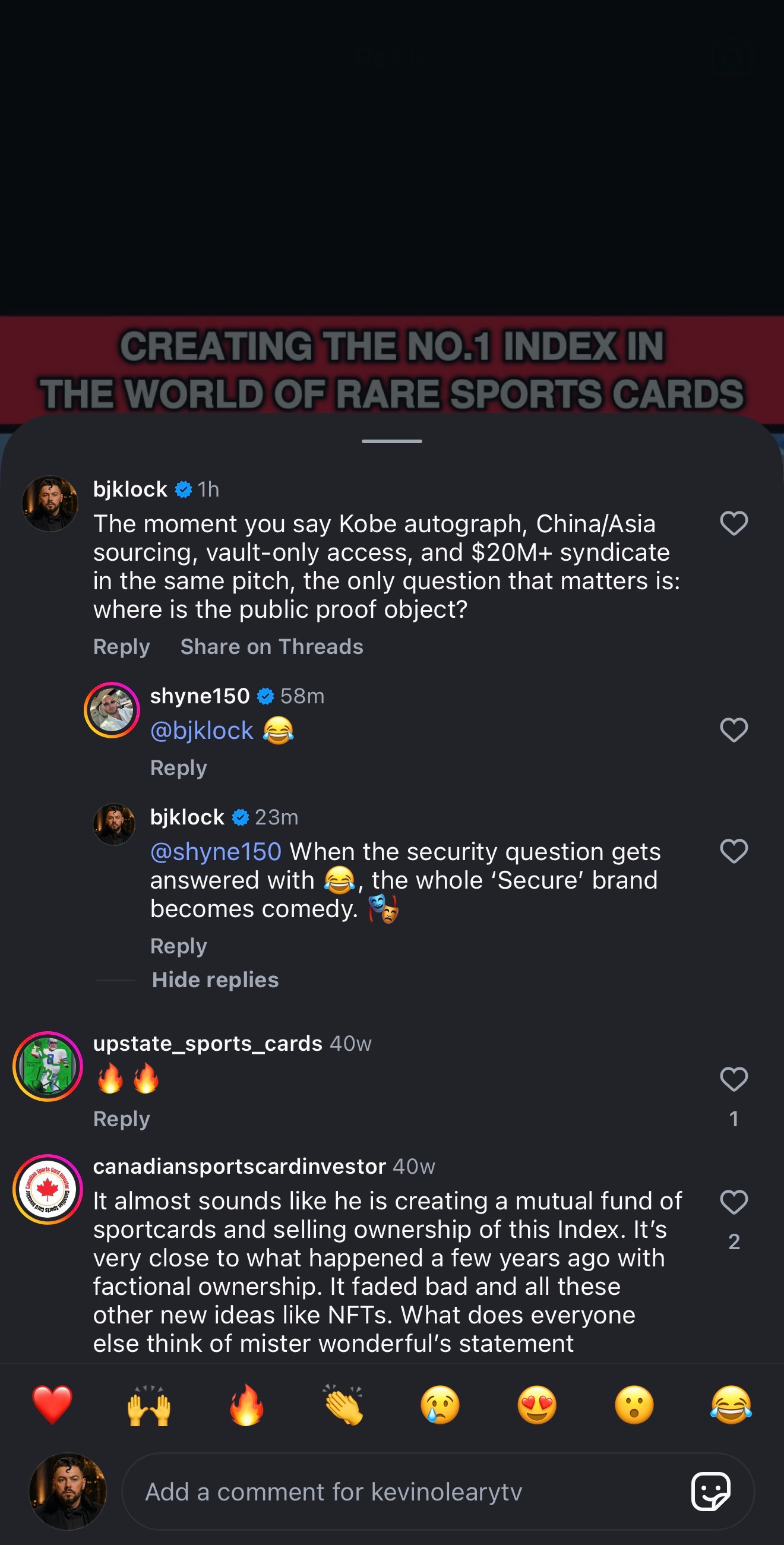
A $32 million claimed index should not be secured by celebrity, curator reputation, slab photos, private access forms, vault language, and laughing emojis.
It should be secured by records.
It should be secured by auditability.
It should be secured by proof.
I. Parties and Market Position
Fanatics is not an ordinary participant in the sports-collectibles market.
Fanatics and its related entities are positioned across multiple layers of the sports-commerce and sports-collectibles ecosystem, including licensed merchandise, official league and player rights, trading-card production, marketplace activity, auction services, live commerce, creator promotion, affiliate marketing, vaulting, and price-reference systems.
That level of vertical integration creates an unavoidable public-interest question:
When the same ecosystem influences supply, demand, auction activity, creator promotion, marketplace visibility, vault custody, and comp formation, what independent proof exists that the resulting prices are real market prices rather than manufactured market signals?
Fanatics must answer this question directly.
The same proof burden applies to any celebrity-backed card index, including any person or entity presenting high-value sports-card assets as an index, portfolio, syndicate, vault collection, museum-grade asset base, or investment-grade collectible product.
If the public is being shown cost basis, index value, rarest-on-Earth language, museum language, vault-only access, celebrity interviews, and private-access funnels, then the public is entitled to proof.
Not aura.
Not branding.
Not “trust me bro.”
Proof.
II. Preservation Demand
Effective immediately, Fanatics, Michael Rubin, Secure Collectibles, WonderShyne Index, Kevin O’Leary, Matt Allen / Shyne150, Paul Warshaw, and all related entities or persons with responsive records are placed on notice to preserve all documents, communications, logs, records, metadata, policies, messages, databases, exports, audit files, and internal analyses relating to the matters identified in this notice.
This preservation demand applies to all responsive records in each party’s possession, custody, or control.
This demand includes, but is not limited to:
Auction bid logs;
Proxy-bid logs;
Max-bid records;
Bidder account histories;
Seller account histories;
Consignor records;
Vault ownership records;
Custody-transfer records;
Relist histories;
Canceled-sale records;
Unpaid-sale records;
Refund records;
Chargeback records;
Private reversal records;
Payment-settlement records;
Internal auction-integrity reviews;
Shill-bidding investigation files;
Employee, contractor, affiliate, creator, agency, investor, seller, consignor, and related-party bidding restrictions;
Known or suspected related-party bidding incidents;
Communications with influencers, breakers, athletes, agencies, celebrity partners, creator partners, affiliates, and paid promoters;
Creator compensation records;
FanCash, credit, bonus, free-product, early-access, event-access, equity, commission, affiliate, referral, and performance-incentive records;
Campaign briefs;
Creator compliance policies;
FTC disclosure policies;
Creator monitoring records;
Marketplace comp methodology;
Sales-history inclusion criteria;
Sales-history exclusion criteria;
Internal pricing models;
Card Ladder or other comp-source integrations;
Buyback, credit, instant-sale, instant-rip, instant-offer, or valuation formulas;
Any communications concerning market perception, price support, comp creation, creator hype, product drops, auction outcomes, or collector sentiment;
Communications relating to PWCC, Fanatics Collect, Fanatics Live, Topps, exclusive licenses, marketplace transitions, rebrands, and historical auction-integrity concerns;
Communications with leagues, player associations, licensing entities, agencies, athletes, retailers, distributors, breakers, dealers, auction houses, grading companies, and marketplace partners concerning exclusivity, pricing, marketplace access, promotion, inventory, auction results, or market control;
Any Secure Collectibles records;
Any WonderShyne Index records;
Any cost-basis records;
Any index-value records;
Any card-by-card ownership records;
Any card-by-card acquisition agreements;
Any card-by-card custody records;
Any vault audit records;
Any insurance schedules;
Any authentication files;
Any grading files;
Any slab imaging files;
Any PSA, BGS, SGC, TAG, CGC, or other grading-company communications;
Any Real Game Used communications;
Any photo-match reports;
Any patch provenance research;
Any media booking communications;
Any Fox News communications;
Any CNBC communications;
Any creator or celebrity compensation records;
Any promotional scripts;
Any statements concerning the Jordan/Kobe Logoman, Jordan/LeBron Logoman, Luka Logoman Auto, or any other asset claimed to be part of the WonderShyne Index.
No party should delete, alter, overwrite, wipe, migrate without retention, disable, anonymize, destroy, or materially modify any responsive information.
This includes Slack, Teams, email, text messages, Signal, WhatsApp, iMessage, Instagram DMs, X/Twitter DMs, CRM notes, internal dashboards, cloud logs, database records, third-party platform exports, backup systems, audit trails, employee devices, contractor systems, and executive communications.
Any routine document-destruction policy, auto-delete policy, retention schedule, ephemeral messaging practice, or database-compaction process that could affect responsive materials must be suspended immediately.
III. Demand for Verified Response
A written, verified response is demanded by:
July 13, 2026, at 5:00 p.m. Eastern Time.
The response must be signed by authorized counsel or by an officer with knowledge and authority to bind the relevant entity.
The response must not be a public-relations statement.
The response must answer the numbered demands below with specificity.
If a recipient contends that a demand does not apply to it, the recipient must state why, identify what records it does control, and identify who controls the remaining records.
IV. Count One: Auction Integrity and Shill-Bidding Controls
Auction rules against bid manipulation are not enough.
The question is whether enforcement can be proven.
Fanatics and any related auction or marketplace entity must answer:
What systems are used to detect shill bidding?
What systems are used to detect self-bidding by consignors?
What systems are used to detect bidding by friends, employees, affiliates, contractors, creators, agencies, investors, family members, related accounts, shell accounts, shared payment methods, shared devices, shared IPs, shared addresses, or coordinated accounts?
Are consignors ever able to bid on their own items directly or indirectly?
Are employees, contractors, creators, affiliates, breakers, athletes, agencies, investors, executives, or related parties restricted from bidding on items where they have a financial or promotional interest?
Are such restrictions automated, manual, policy-based, or enforced only after complaint?
How many suspected shill-bidding incidents have been identified from January 1, 2021, through the present?
How many accounts have been suspended, banned, warned, restricted, or investigated for shill bidding or bid manipulation?
How many auctions were canceled, reversed, relisted, corrected, excluded from comps, or otherwise modified due to suspected bid manipulation?
Does the marketplace publish any public proof that a completed auction was paid, final, independent, and free from related-party bidding?
If not, why should collectors treat final auction prices as reliable market truth?
V. Count Two: PWCC / Fanatics Collect Historical Integrity
Fanatics acquired PWCC and later transitioned PWCC services into Fanatics Collect.
Fanatics therefore cannot avoid the historical integrity question by rebranding the marketplace.
Fanatics must answer:
What auction-integrity audit was performed before or after the PWCC acquisition?
Were historical PWCC auction records reviewed for shill bidding, self-bidding, related-party bidding, unpaid sales, canceled sales, relists, or suspicious bidding patterns?
Were any historical PWCC comps removed, flagged, corrected, or downgraded after the acquisition?
Were any PWCC employees, systems, accounts, policies, practices, consignor relationships, bidder relationships, vault records, or auction databases retained by Fanatics?
If retained, what integrity controls were changed?
If not changed, why not?
Did Fanatics conduct any independent third-party audit of PWCC auction data?
If yes, identify the auditor, date, scope, and conclusions.
If no, explain why historical marketplace trust was transferred into Fanatics Collect without public independent verification.
VI. Count Three: Comp Formation and Price Laundering Risk
The central collector-protection issue is not only whether one auction is manipulated.
The central issue is whether a questionable auction result becomes a public comp and then circulates as “market value.”
Fanatics and any related marketplace, auction, valuation, or data entity must answer:
What qualifies a sale for inclusion in sales history or comp data?
Are unpaid sales excluded?
Are canceled sales excluded?
Are refunded sales excluded?
Are chargebacks excluded?
Are private reversals excluded?
Are relisted items tied to prior failed sale attempts?
Are buyer premiums separated from hammer price?
Are creator-promoted sales flagged?
Are employee, affiliate, creator, contractor, agency, investor, athlete, consignor, or related-party bids excluded from comp formation?
Are sales involving internal credits, FanCash, promotional credits, platform credits, or non-cash consideration identified separately?
Are comps ever used to support instant offers, buybacks, credits, marketplace valuation, pricing recommendations, or collector-facing “market value” displays?
If yes, what prevents a dirty comp from becoming a price anchor?
Does the marketplace maintain a public comp-eligibility ledger?
If not, why not?
VII. Count Four: Creator, Influencer, Breaker, Affiliate, and Paid-Promotion Disclosures
Creator-led commerce may be lawful when properly disclosed.
But undisclosed material connections can deceive collectors, especially when creator hype affects perceived market value.
Fanatics and any related platform, creator, affiliate, or promotional entity must answer:
Which creators, influencers, breakers, athletes, celebrities, hobby accounts, media accounts, streamers, or affiliates have received compensation from Fanatics or related entities?
Which have received commissions?
Which have received FanCash?
Which have received free product?
Which have received early access?
Which have received platform credits?
Which have received performance bonuses?
Which have received travel, event access, hospitality, or appearance opportunities?
Which have received equity, options, warrants, revenue share, referral fees, or other economic upside?
Which have been allowed to promote products, auctions, breaks, marketplace listings, comps, or card values while also holding, buying, selling, consigning, or receiving the same or related inventory?
What exact disclosure language is required?
Where must disclosure appear?
Are creator posts audited for compliance?
How many creator posts have been flagged for inadequate disclosure?
How many creators have been warned, suspended, removed, or penalized for disclosure failures?
Does Fanatics maintain a public ledger showing which creators are economically connected to Fanatics?
If not, why should collectors trust creator-driven demand signals?
VIII. Count Five: Vertical Integration and Market Power
Fanatics’ position across official rights, supply, marketplace access, auctions, live commerce, creators, and comps creates structural conflicts that demand answers.
Fanatics must answer:
Does Fanatics deny that it holds substantial market power in official sports trading-card production and distribution?
Does Fanatics deny that exclusive licensing arrangements materially affect competition?
Does Fanatics deny that vertical integration across production, marketplace, auction, live commerce, vaulting, and creator promotion creates conflicts of interest?
What independent safeguards separate Fanatics’ production incentives from marketplace price formation?
What independent safeguards separate Fanatics’ creator-promotion incentives from auction and comp formation?
What independent safeguards prevent official licensing power from being used to disadvantage competitors?
What independent safeguards prevent Fanatics from using marketplace data to benefit its own products, releases, partners, or preferred channels?
Has Fanatics submitted its trading-card and collectibles ecosystem to an independent antitrust or market-structure audit?
If yes, produce the scope and conclusions.
If no, explain why a company with this level of control should not be required to do so.
IX. Count Six: Collector Harm and Reliance
Collectors rely on marketplace signals.
Fathers, sons, shops, breakers, investors, hobbyists, and ordinary fans rely on posted prices, sold listings, auction results, creator commentary, sales history, card-ladder displays, and market-value claims.
If those signals are contaminated by undisclosed compensation, related-party bidding, unpaid sales, canceled transactions, artificial price support, platform credits, undisclosed promotional incentives, or vertically integrated self-interest, collectors can be misled.
Fanatics and any related marketplace or promotional entity must answer:
What collector-protection policy governs comp accuracy?
What collector-protection policy governs creator disclosures?
What collector-protection policy governs related-party bidding?
What collector-protection policy governs platform credits and non-cash consideration?
What collector-protection policy governs correction of tainted comps?
What public notice is given when a comp is later determined to be unreliable?
Are prior buyers notified when a comp they may have relied upon is removed or corrected?
Are regulators notified of suspected systematic auction manipulation?
Is restitution or remediation provided where buyers relied on tainted marketplace information?
If no, why not?
X. Count Seven: High-End Card Indexes, Celebrity Promotion, and Public Proof Objects
The sports-collectibles market is now being sold as an alternative asset class.
When a person or entity publicly presents a high-value card portfolio as an “index,” assigns a cost basis or index value, promotes that portfolio through celebrity media, restricts access through private forms or vault-only inspection, and uses slabs, auction prices, private deals, or curator reputation as proof, the burden of verification increases.
The issue is not whether rare cards can be valuable.
The issue is whether collectors, media outlets, investors, and the public are being asked to rely on opaque authority signals instead of verifiable proof.
The relevant question is simple:
Where is the public proof object?
Any person or entity presenting a high-value sports-card index must answer:
What cards are included in the index?
Who owns each card?
Who has beneficial ownership of each card?
Who has physical custody of each card?
Where is each card vaulted?
Who independently audits the vault?
What insurance schedule covers each asset?
What authentication history exists for each card?
What grading history exists for each card?
What slab-substitution defense exists for each card?
What patch-provenance history exists for each memorabilia card?
What photo-match evidence exists for each game-used patch?
Was photo-matching completed before purchase, after purchase, or not yet completed?
What transfer trail exists from issuance to current custody?
Were any cards purchased privately?
Were any cards purchased from related parties, advisors, partners, insiders, or affiliates?
Were any cards purchased after celebrity or influencer promotion increased public market attention?
Were any valuations based on paid, final, independent transactions?
Were any valuations based on private offers, internal estimates, media claims, or speculative appreciation?
Were any cards promoted while authentication, photo-matching, custody review, or valuation review remained incomplete?
Does the index maintain a public verifier showing custody, provenance, valuation method, and substitution defense?
Does the index publicly disclose methodology for cost basis?
Does the index publicly disclose methodology for index value?
Does the index separate paid purchase price from claimed current value?
Does the index identify whether valuations come from third-party appraisal, internal estimate, insurance value, sale comp, private offer, or promotional claim?
If the answer is no, then the index should not be presented as secure, investment-grade, or institutionally proven.
A laughing emoji is not provenance.
A vault photo is not provenance.
A celebrity interview is not provenance.
A slab label is not provenance.
A QR code is not custody.
A cert lookup is not substitution defense.
A public proof object is required.
XI. Count Eight: Slab Authentication, Cert Cloning, and Substitution Defense
The slab is not the asset.
The slab is a wrapper around the asset.
The label is not the asset.
The QR code is not the asset.
The cert number is not the asset.
The question is whether the physical object in the holder is the same object that was authenticated, graded, transferred, vaulted, insured, valued, and promoted.
Any party relying on PSA, BGS, SGC, TAG, CGC, or any other grading or authentication layer as a basis for high-value promotion must answer:
What prevents cert-number cloning?
What prevents fake slab presentation?
What prevents label duplication?
What prevents slab substitution?
What prevents a real cert number from being attached to a different physical object?
What prevents patch replacement?
What prevents autograph tracing, alteration, or substitution?
What prevents altered cards from entering high-value presentation?
What imaging record exists at each custody event?
What forensic inspection occurred at acquisition?
What forensic inspection occurred before media presentation?
What forensic inspection occurred before index valuation?
What independent party verified that the item in the current slab is the same item that generated the original authentication record?
Does the public have access to a verifier beyond a cert number?
If not, why should a cert lookup be treated as proof of an eight-figure object?
The market cannot continue pretending that tamper-evident packaging equals tamper-proof custody.
It does not.
XII. Required Production Categories
Fanatics and all relevant notice parties are requested to produce or make available for inspection the following categories of records for the period January 1, 2021, through the present:
Auction-integrity policies;
Shill-bidding detection policies;
Related-party bidding policies;
Employee bidding policies;
Consignor bidding policies;
Creator bidding and selling policies;
Affiliate and creator contracts;
FTC disclosure policies;
Creator compliance audits;
FanCash, credit, bonus, and free-product records tied to creators and affiliates;
Sales-history inclusion and exclusion rules;
Comp-eligibility rules;
Records of unpaid sales removed from sales history;
Records of canceled, refunded, reversed, relisted, or corrected auction results;
Records of internal auction-integrity investigations;
Records of complaints concerning bid manipulation;
Records of suspended or restricted accounts for bid manipulation;
Records of marketplace methodology used to assign or display market value;
Any independent audits concerning PWCC, Fanatics Collect, Fanatics Live, Topps, auction activity, creator disclosure, marketplace pricing, or comp formation;
Any board-level or executive-level communications discussing auction integrity, shill bidding, creator disclosure, comp accuracy, market manipulation, price perception, Fanatics Collect, PWCC, or trading-card market dominance;
Any Secure Collectibles or WonderShyne Index ownership records;
Any WonderShyne cost-basis records;
Any WonderShyne index-value records;
Any acquisition invoices;
Any payment confirmations;
Any beneficial ownership schedules;
Any syndicate agreements;
Any private-access investor materials;
Any vault agreements;
Any vault audit reports;
Any insurance schedules;
Any authentication records;
Any grading records;
Any slab imaging records;
Any photo-match records;
Any Real Game Used communications;
Any patch provenance research;
Any appraisal reports;
Any valuation memos;
Any public-relations briefs;
Any media talking points;
Any Fox News, CNBC, Instagram, TikTok, YouTube, X/Twitter, or podcast promotion records;
Any celebrity, creator, affiliate, or media compensation records tied to card promotion, index promotion, asset-value claims, or public market perception.
XIII. Required Certifications
Each relevant party must certify the following by July 13, 2026:
Whether routine deletion of responsive records has been suspended;
Whether executive communications have been preserved;
Whether creator and affiliate communications have been preserved;
Whether auction logs and bid metadata have been preserved;
Whether payment-settlement records have been preserved;
Whether sales-history and comp-eligibility records have been preserved;
Whether records from PWCC-era systems and Fanatics Collect transition systems have been preserved;
Whether Secure Collectibles records have been preserved;
Whether WonderShyne Index records have been preserved;
Whether vault records have been preserved;
Whether custody records have been preserved;
Whether insurance records have been preserved;
Whether authentication and grading records have been preserved;
Whether photo-match and patch-provenance records have been preserved;
Whether promotional compensation records have been preserved;
Whether any responsive records have been deleted, modified, overwritten, or lost since January 1, 2021;
If records were deleted or lost, what was deleted, when, by whom, under what policy, and whether backups exist.
XIV. Notice of Potential Claims and Regulatory Issues
The conduct and structure described above may implicate, depending on facts discovered, issues under federal and state antitrust law, unfair and deceptive acts and practices law, auction-integrity duties, false advertising law, consumer-protection statutes, endorsement and disclosure rules, unfair competition law, tortious interference principles, unjust enrichment theories, civil conspiracy theories, negligent misrepresentation, fraud-based claims, and any other applicable statutory or common-law remedies.
This notice does not assert that any regulator, prosecutor, court, or jury has already made such findings.
This notice states that the current structure creates serious and specific questions that must be answered.
The relevant parties are invited to resolve those questions through verified records, transparent methodology, independent auditability, and meaningful public accountability.
XV. Demand for Public Proof Standard
The sports-collectibles market should adopt and publish a collector-protection standard requiring that any marketplace price used as a comp be verified as:
Paid;
Final;
Not refunded;
Not canceled;
Not reversed;
Not relisted due to nonpayment;
Free from seller self-bidding;
Free from related-party bidding;
Free from undisclosed employee, contractor, affiliate, creator, athlete, agency, investor, or insider participation;
Separated from buyer premium;
Separated from platform credits or non-cash consideration;
Flagged if promoted by paid creators or affiliates;
Traceable to a public comp-eligibility record.
Any high-value card index should also publish a card-by-card proof standard showing:
Ownership;
Beneficial ownership;
Custody chain;
Vault location;
Vault audit;
Insurance schedule;
Authentication history;
Grading history;
Slab imaging;
Slab-substitution defense;
Patch provenance;
Photo-match status;
Transfer trail;
Acquisition date;
Acquisition price;
Valuation methodology;
Current valuation source;
Related-party disclosure;
Promotional compensation disclosure;
Public verifier.
If this standard cannot be met, opaque auction outcomes and celebrity-backed index values should not be presented as market truth.
XVI. Demand for Response by Date Certain
A verified written response is demanded no later than:
July 13, 2026, at 5:00 p.m. Eastern Time.
The response must address each numbered section of this notice.
A generic denial, brand statement, public-relations reply, laughing emoji, or unsupported assertion of compliance will not be treated as a substantive response.
XVII. Notice of Next Steps if No Substantive Response Is Received
If no substantive verified response is received by July 13, 2026, the undersigned reserves all rights to proceed without further notice, including but not limited to:
Filing antitrust complaints with the Federal Trade Commission and the United States Department of Justice Antitrust Division;
Filing consumer-protection complaints with applicable state attorneys general;
Submitting endorsement and disclosure concerns to the Federal Trade Commission;
Providing the documented record to civil counsel for review of potential claims;
Coordinating with affected collectors, shops, sellers, creators, and market participants;
Seeking preservation, discovery, subpoenas, public-record requests where applicable, and other lawful investigative tools;
Notifying relevant leagues, player associations, licensors, consumer-protection bodies, market participants, and media organizations of the unanswered questions;
Publishing a factual record of the unanswered demands, provided such publication is truthful, evidence-based, and legally reviewed.
Nothing in this notice waives any right, remedy, claim, defense, privilege, or position.
All rights are expressly reserved.
XVIII. Final Public Proof Demand
The sports-card market does not need another celebrity index.
It does not need another private vault story.
It does not need another influencer pump.
It does not need another slab-photo trust ritual.
It does not need another “trust me bro” comp.
It needs a public proof standard.
No public custody chain, no security.
No substitution defense, no provenance.
No verified comp methodology, no market truth.
No creator-compensation disclosure, no clean demand signal.
No patch provenance, no memorabilia claim.
No vault audit, no vault trust.
No object-carried proof, no infrastructure.
Michael Rubin and Fanatics have built an empire around fan trust.
Kevin O’Leary, Secure Collectibles, WonderShyne, Shyne150, and related parties are publicly presenting high-value sports cards as rare, secure, investment-grade assets.
The question now is whether that trust is backed by proof.
Collectors are entitled to know whether the prices shown to them are real, paid, independent, final, and free from undisclosed influence.
Collectors are entitled to know whether the assets being promoted to them are protected against substitution, cert cloning, slab duplication, patch fraud, autograph fraud, custody fiction, and valuation theater.
The answer cannot be branding.
It cannot be philanthropy.
It cannot be celebrity.
It cannot be a vault photo.
It cannot be a generic statement.
It cannot be a laughing emoji.
It must be records.
It must be certifications.
It must be methodology.
It must be auditability.
It must be proof.
The age of “trust me bro” collectibles is over.
Respectfully,
☤ K℞K Φ.K.
BJ Klock
Receiz.com/bjklock
NOTICE IS LIVE.
The sports-card market does not need another celebrity index, private vault story, influencer pump, or slab-photo trust ritual.
It needs a public proof standard.
No public custody chain, no security.
No substitution defense, no provenance.
No verified comp methodology, no market truth.
No object-carried proof, no infrastructure.
The age of “trust me bro” collectibles is over.
The source set below covers the Fanatics/Topps and PWCC acquisition record, FTC endorsement guidance, PSA cert-risk warning, Kevin O’Leary’s FTX testimony, the DOJ SBF sentencing record, the Logan Paul / Shyne150 Pokémon case reporting, and the Jordan/Kobe / WonderShyne / Real Game Used record.
APPENDIX A
PUBLIC SOURCE RECORD, FULL LINKS, AND RELEVANCE INDEX
This appendix is incorporated by reference into the Notice of Preservation, Demand for Verified Response, and Public Market-Integrity Notice.
The source URLs below are written in full for public review, copying, preservation, and independent verification.
This appendix does not allege that any specific current card is counterfeit.
This appendix does not allege that any specific person knowingly sold a counterfeit item without discovery.
This appendix identifies public records, official statements, reporting, and source materials relevant to the questions raised in the notice: auction integrity, comp formation, creator disclosure, market concentration, slab authentication, cert-cloning risk, vault custody, high-end index valuation, promotional history, and public proof-object standards.
A. Fanatics Market Position, Topps Acquisition, PWCC Acquisition, and Vertical Integration
Source A-1: Fanatics acquisition of Topps trading-card and collectibles business
Relevance: Fanatics’ official release states that Fanatics completed the acquisition of Topps’ trading-card and collectibles business. This source is relevant to Fanatics’ position in licensed trading cards, sports collectibles, and official-card production.
Source A-2: Fanatics / ESPN page concerning acquisition of PWCC Marketplace
Full URL:
https://www.fanaticsinc.com/news/espn-fanatics-continues-push-into-collecting-space-acquires-pwcc
Relevance: Fanatics’ site hosts coverage stating that Fanatics Collectibles acquired PWCC Marketplace, one of the world’s largest sports-card, memorabilia, and collectible auction houses, and noting PWCC’s vault business.
Source A-3: ESPN coverage of Fanatics Collectibles acquiring PWCC Marketplace
Full URL:
https://www.espn.com/espn/story/_/id/37709968/fanatics-collectibles-acquires-pwcc-marketplace
Relevance: ESPN reported that Fanatics Collectibles acquired PWCC Marketplace. This is relevant to auction, marketplace, vaulting, comp formation, and historical marketplace-integrity questions.
B. FTC Endorsement, Influencer, Creator, Affiliate, and Material-Connection Disclosure Standards
Source B-1: FTC Endorsement Guides — What People Are Asking
Full URL:
https://www.ftc.gov/business-guidance/resources/ftcs-endorsement-guides-what-people-are-asking
Relevance: FTC guidance discusses endorsement disclosures, material connections, influencers, advertisers, and the importance of context in determining whether a disclosure is needed and sufficient.
Source B-2: FTC Endorsements, Influencers, and Reviews guidance hub
Full URL:
https://www.ftc.gov/business-guidance/advertising-marketing/endorsements-influencers-reviews
Relevance: FTC guidance hub for endorsements, influencers, reviews, and disclosure obligations. This is relevant to creators, breakers, athletes, celebrities, affiliates, and paid promoters influencing collector demand or market perception.
C. PSA, Slab Authentication, Cert Lookup, and Substitution-Risk Sources
Source C-1: PSA Cert Verification warning
Full URL:
https://www.psacard.com/cert
Relevance: PSA warns that verification of certification numbers in the PSA database does not eliminate risk, and that criminals may counterfeit PSA grading inserts using real certification numbers derived from public sources. This is directly relevant to cert cloning, slab substitution, QR-code reliance, and high-value card proof standards.
Source C-2: PSA Security: A Buyer’s Guide
Full URL:
https://www.psacard.com/services/psasecurityabuyersguide
Relevance: PSA security materials are relevant to holder security, label security, tamper-evident packaging, and the distinction between anti-counterfeit packaging and public object-level provenance.
Source C-3: Beckett grading and authentication service page
Full URL:
https://www.beckett.com/grading
Relevance: Beckett’s grading/authentication services are relevant to the broader question of slab-dependent trust, third-party authentication, holder security, and whether grading-company wrappers are being treated as full custody/provenance systems.
D. Kevin O’Leary, FTX Promotion, and Public Trust-Failure Record
Source D-1: Kevin O’Leary Senate Banking testimony concerning FTX
Full URL:
https://www.banking.senate.gov/download/oleary-testimony-12-14-22
Relevance: Kevin O’Leary testified that he entered into an agreement with FTX to be a paid spokesperson and was paid approximately $15 million for those services. This is relevant to celebrity promotion, paid endorsement, public trust, and market reliance.
Source D-2: United States Department of Justice — Sam Bankman-Fried sentenced to 25 years
Full URL:
https://www.justice.gov/usao-sdny/pr/samuel-bankman-fried-sentenced-25-years-prison
Relevance: DOJ announced that Samuel Bankman-Fried was sentenced to 25 years in prison and faced forfeiture of over $11 billion. This is relevant to the public record surrounding FTX, paid promotion, trust failure, and celebrity-backed financial narratives.
Source D-3: DOJ archive page concerning Samuel Bankman-Fried sentencing
Relevance: Additional DOJ source concerning the same sentencing record and forfeiture figure.
E. Logan Paul, Matt Allen / Shyne150, BBCE Authentication Failure, and Fake Pokémon Case Record
Source E-1: Action Network report on Logan Paul fake Pokémon case
Full URL:
https://www.actionnetwork.com/boxing/logan-paul-gets-duped-buying-3-million-fake-pokemon-cards
Relevance: Action Network reported that Logan Paul bought a $3.5 million Pokémon case that turned out fake and contained G.I. Joe packs, and that the box was sold to him by high-end card dealer Matt Allen, known as Shyne150. This source is relevant to high-value collectibles, third-party authentication failure, sealed-object trust, reputation-based dealing, and the need for public proof standards.
Source E-2: Bleacher Report coverage of Logan Paul fake Pokémon cards
Relevance: Additional public reporting concerning Logan Paul’s fake $3.5 million Pokémon-card purchase.
Source E-3: Darren Rovell public post concerning Matt Allen reimbursement
Full URL:

Relevance: Public post stating that Matt Allen, who sold what turned out to be a fake Pokémon case to Logan Paul for $3.5 million, said he reimbursed Paul in full. This is relevant to the public record, while not establishing knowledge or intent.
F. Jordan / Kobe Dual Logoman, WonderShyne Index, Secure Collectibles, and High-End Card Index Record
Source F-1: Heritage Auctions press release on Jordan/Kobe Dual Logoman sale
Relevance: Heritage Auctions announced that the 1-of-1 Michael Jordan / Kobe Bryant Dual Logoman card sold for $12,932,000 in Heritage’s Summer Platinum Night Sports Auction. This is relevant to the record sale, comp formation, auction-price reliance, and high-end card valuation.
Source F-2: Heritage Auctions lot page for 2007-08 Upper Deck Exquisite Collection Dual Logoman Autographs Michael Jordan and Kobe Bryant
Relevance: Heritage lot page for the Jordan/Kobe Dual Logoman, including auction result and lot details. Relevant to card identity, sale price, grading reference, and auction provenance.
Source F-3: ESPN report on Jordan/Bryant card selling for record $12.9 million
Full URL:
https://www.espn.com/nba/story/_/id/46061949/holy-grail-jordan-bryant-sports-card-sells-record-129m
Relevance: ESPN reported that the Jordan/Bryant card sold for $12.932 million and became the most expensive sports card sold at auction. Relevant to public price perception and media amplification.
Source F-4: Reuters report on Michael Jordan / Kobe Bryant card record sale
Full URL:
https://www.reuters.com/sports/michael-jordan-kobe-bryant-card-sells-record-sum-2025-08-24/
Relevance: Reuters reported the Jordan/Kobe card sale and its record-setting price. Relevant to broad public dissemination of the sale as market fact.
Source F-5: CLLCT report identifying Kevin O’Leary, Matt Allen / Shyne150, and Paul Warshaw as buyers
Relevance: CLLCT reported that Kevin O’Leary said he bought the $12.932 million card with business partners Matt Allen and Paul Warshaw. Relevant to ownership, promotion, syndicate/index presentation, and celebrity-backed valuation claims.
Source F-6: Sports Collectors Digest report on Jordan/LeBron Logoman sale and WonderShyne portfolio growth
Relevance: Sports Collectors Digest reported a $10 million Jordan/LeBron Logoman sale and described the investment group adding to a high-value portfolio. Relevant to index growth, portfolio valuation, comp formation, and high-end market concentration.
Source F-7: Nasdaq press release concerning WonderShyne Index selecting Real Game Used for photo-match analysis
Relevance: Press release states that Real Game Used was commissioned by Kevin O’Leary’s WonderShyne Index to conduct photo-match authentication analysis on the Jordan/Kobe Dual Logoman card. The release uses conditional language regarding whether a conclusive photo match would be achieved. Relevant to patch provenance, valuation methodology, and whether deeper provenance was completed before or after purchase/promotion.
Source F-8: OTC Markets version of Real Game Used / WonderShyne photo-match release
Relevance: Additional version of the same release concerning Real Game Used, WonderShyne Index, and attempted photo-match analysis. Relevant to preservation and independent source review.
G. Subject Websites and Public-Facing Presentation Sources
Source G-1: Secure Collectibles website
Full URL:
https://www.securecollectibles.com/
Relevance: Public-facing website for Secure Collectibles. Relevant to private-access presentation, WonderShyne Index presentation, public valuation claims, public proof-object questions, and screenshots requiring preservation.
Source G-2: Real Game Used website
Full URL:
https://www.realgameused.com/
Relevance: Public-facing website for Real Game Used, the entity referenced in press releases concerning photo-match authentication analysis.
Source G-3: Secure Collectibles Instagram profile
Full URL:
https://www.instagram.com/secure/
Relevance: Public-facing social account associated with Secure Collectibles. Relevant to public promotion, media clips, audience targeting, and preservation of posts, comments, replies, and promotional claims.
Source G-4: Kevin O’Leary Instagram profile
Full URL:
https://www.instagram.com/kevinolearytv/
Relevance: Public-facing social account used for promotional content and public statements. Relevant to preservation of posts, captions, comments, replies, and public valuation or index claims.
Source G-5: Matt Allen / Shyne150 Instagram profile
Full URL:
https://www.instagram.com/shyne150/
Relevance: Public-facing social account associated with Matt Allen / Shyne150. Relevant to preservation of public posts, replies, comments, promotional claims, and any statements concerning Secure Collectibles, WonderShyne, or high-value card assets.
H. Regulatory and Complaint Submission Links
Source H-1: FTC fraud report portal
Full URL:
https://reportfraud.ftc.gov/
Relevance: Public FTC portal for reporting fraud, scams, and deceptive business practices.
Source H-2: FTC antitrust violation information page
Relevance: FTC guidance for reporting antitrust concerns.
Source H-3: United States Department of Justice Antitrust Division — report violations
Full URL:
https://www.justice.gov/atr/report-violations
Relevance: DOJ Antitrust Division portal for reporting antitrust concerns.
Source H-4: National Association of Attorneys General — find state attorney general
Full URL:
https://www.naag.org/find-my-ag/
Relevance: Directory for identifying state attorneys general for consumer-protection submissions.
Source H-5: FTC endorsement guidance for influencers, advertisers, and marketers
Full URL:
https://www.ftc.gov/business-guidance/resources/ftcs-endorsement-guides-what-people-are-asking
Relevance: Relevant to creator, affiliate, athlete, celebrity, influencer, breaker, and paid-promotion disclosure issues.
APPENDIX B
SCREENSHOT AND RECORD-PRESERVATION INDEX
The author has retained or intends to retain screenshots, screen recordings, URLs, timestamps, account handles, captions, comment threads, replies, public-facing website pages, valuation displays, private-access forms, and public promotional materials relevant to the matters described in the notice.
This includes, without limitation:
Screenshots of public Secure Collectibles website pages showing the WonderShyne Index.
Screenshots of public Secure Collectibles pages displaying cost-basis or index-value claims.
Screenshots of public Secure Collectibles private-access forms.
Screenshots of Instagram posts or reels promoting the WonderShyne Index.
Screenshots of public comments asking for proof, provenance, custody chain, substitution defense, or a public proof object.
Screenshots of public replies to proof questions.
Screenshots of public claims concerning card value, index value, cost basis, vault access, museum display, rarity, or syndicate ownership.
Screenshots of public media clips involving Kevin O’Leary, Secure Collectibles, WonderShyne, Shyne150, or related parties.
Screenshots of public statements concerning China/Asia sourcing, domestication of cards, vault-only access, or card-origin claims, where applicable.
Screenshots of public-facing card images, slab images, cert numbers, labels, QR codes, patch images, autograph images, and any related visual proof presented to the public.
All such screenshots and records should be preserved by all parties with access to the underlying posts, pages, analytics, drafts, deleted content, archived content, social-media backend records, comment moderation records, direct messages, media-planning documents, creator agreements, and promotional records.
APPENDIX C
LIMITED SOURCE-USE STATEMENT
The sources listed in Appendix A are cited only for the specific public-record facts identified.
No source is cited as proof that any current card is counterfeit.
No source is cited as proof that any specific person acted knowingly or intentionally without discovery.
No source is cited as proof that any specific marketplace transaction was manipulated without discovery.
The purpose of the source record is to show why verified answers, preservation, disclosure, auditability, and public proof standards are necessary.
The public record already shows that high-value collectibles, sealed packaging, grading wrappers, celebrity promotion, authentication confidence, and public valuation claims can fail.
Therefore, the market must not be asked to rely on reputation, celebrity, curator trust, vault language, slab photos, cert lookups, or private-access branding as substitutes for proof.
The required standard is:
Paid.
Final.
Independent.
Conflict-screened.
Properly disclosed.
Custody-verified.
Substitution-defended.
Publicly auditable.
Object-proven.
Anything less is not market integrity.
It is trust theater.