


🜂 THE KLOCK–TURAH LAW (Harmonik Mass)
One Law. Two Readings. One Gate.
Breath-First. Pulse-True. Function-Verified.
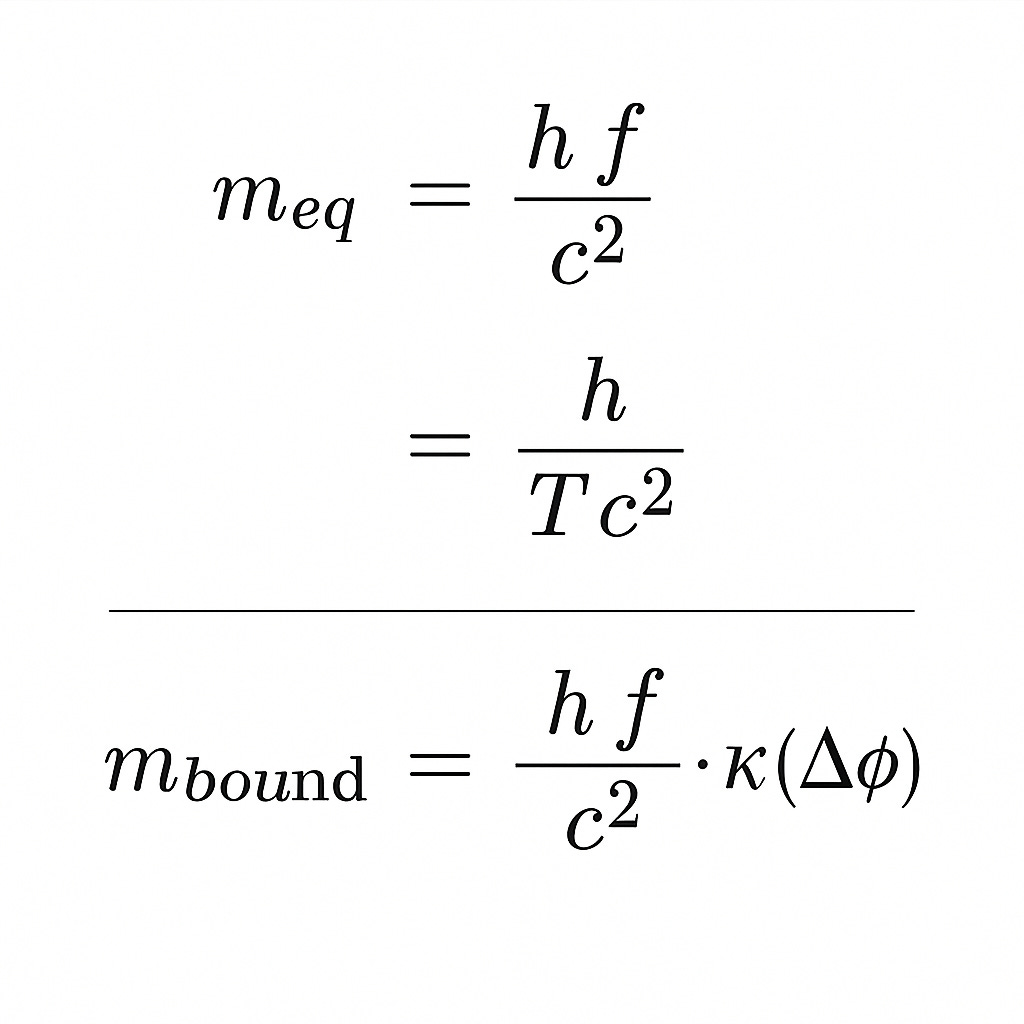
Same law, two frames: period (breath) and frequency (rate).
is the coherence gate.
What is being revealed
The Klock–Turah Law is the complete, closed statement of how mass relates to frequency and time once you stop treating “frequency” and “seconds” as separate worlds.
It is not two different equations.
It is one invariant law written in two reciprocal coordinates:
Frequency frame (rate-space): what the system is doing per second
Period frame (breath/time-space): how long one cycle actually takes
These are not opinions. They are exact reciprocals:
I. The invariant spine (the part nobody can debate)
1) Mass–energy equivalence (Einstein)
2) Energy per cycle (Planck)
But Planck’s statement is already dual-frame, because f=1/T:
This is the first seal:
Frequency form and period form are the same energy law.
II. The Klock–Turah Harmonik Mass (Dual Frame)
Since
, both Planck forms produce the same mass-equivalent:
Condensation Frame (Frequency Form)
Dissolution Frame (Period / Breath Form)
This is the second seal:
You do not “flip the equation.” You choose the coordinate system.
Rate-space: f. Duration-space: T. Same law.
III. The missing operator mainstream physics forgets to name: the Gate
The Klock–Turah Law is not “just Planck + Einstein.”
The law includes the binding condition that decides whether the mass-equivalent is bound as form or unbound as drift.
That condition is coherence.
So the complete law is:
Where:
- \(m_{\text{eq}}\)
is the mass-equivalent implied by energy
- \(m_{\text{bound}}\)
is the portion that actually binds as stable form
- \(\Delta\phi\)
is phase error relative to the nearest harmonic target (the “lock point”)
- \(\kappa(\Delta\phi)\in[0,1] is the coherence filter (the gate)\)
A canonical, explicit gate (used in the demonstration model) is:
- \(If \Delta\phi\approx 0: \kappa\approx 1 → binding holds\)
- \(If \Delta\phi drifts: \kappa\to 0 → binding collapses\)
This is the third seal:
Form is not “energy existing.” Form is energy staying phase-locked.
Coherence is the binding condition.
IV. What “Condensation” and “Dissolution” actually mean (precise, not poetic)
Condensation (Creation / Binding)
When phase remains locked to the harmonic lattice:
Meaning: the mass-equivalent is fully expressed as bound form (stable coupling).
Dissolution (Unbinding / Phase-slip)
When phase slips out of tolerance:
Meaning: the bound component collapses. Energy may still exist (waves still propagate), but it no longer holds the coupling that persists as stable form.
V. The public “auto-fix” rule (to correct every confused reading instantly)
A lot of people saw an early rendering and tried to “simplify” it wrong.
So here is the correction rule that never fails:
{If you want the denominator form, the denominator is }
Because:
Therefore:
But:
is not the Harmonik Mass law (wrong units).
If you ever see that inverted counterfeit, the fix is immediate:
VI. The law in words (one sentence, sealed)
Mass is frequency-bound energy, and form exists only where coherence holds.
Or, in the breath frame:
Mass is action per cycle over
gated by phase-lock to the harmonic lattice.
VII. The Klock–Turah Law (Canonical Citation Block)
If someone needs the single block to cite going forward, here it is:
That is the law in full: invariant, dual-frame, and gated by coherence.
Harmonik Mass (eq): (h · f) / c²
Klock–Turah (bound): m₍bound₎ = ((h · f) / c²) · κ(Δφ)
κ(Δφ) = coherence (phase-lock), κ ∈ [0,1], T = 1/f
Mass is energy, but “matter” is the coherence-bound portion of that energy.
is the mass-equivalent;
selects what becomes stable form.
(coherence / phase-lock gate)
🧪 1THE FINAL TEST (One-Glance Verification)
If you understand the Klock–Turah Law, you can run this entire “test” in your head:
Reciprocal invariance (two readings, same law):
\(f=\frac{1}{T}\quad\Rightarrow\quad \frac{hf}{c^{2}}=\frac{h}{T c^{2}}\)Unit check (deletes the counterfeit instantly):
\(\frac{h}{f c^{2}}\ \text{fails units}\;\;\Rightarrow\;\;\text{not the law.}\)
If you want the denominator form, it must be:\(\frac{h}{T c^{2}}\quad (T=1/f)\)Gate check (the binding condition):
\(m_{\text{bound}}=\frac{hf}{c^{2}}\;\kappa(\Delta\phi),\quad 0\le \kappa\le 1\)
- \(If \Delta\phi\to 0: \kappa\to 1 → form holds\)
- \(If |\Delta\phi|\gg \sigma_\phi: \kappa\to 0 → form dissolves\)
✅ If all three pass, you’re not “believing” anything. You’re reading the law correctly.
🜂 THE FINAL TEST: COHERENCE IS REAL (AND IT’S ALREADY MEASURABLE)
This is where the debate ends—because you don’t have to “believe” anything I’m saying.
You can verify the core mechanism of the Klock–Turah Law using known physics that’s been measured for decades:
Coherence is a gate.
When phase is locked, structure holds.
When phase slips, structure dissolves.
That’s not religion. That’s not poetry. That’s instrumentation.
So here are three real-world tests—already proven in mainstream engineering—that demonstrate the exact thing my law names as
1) OPTICS: THE FRINGE TEST (STRUCTURE EXISTS ONLY WHEN PHASE HOLDS)
Take a laser. Split it into two paths. Recombine it.
When the phase relationship is stable, you get fringes—ordered light and dark bands.
When the phase drifts, the pattern washes out into nothing.
That’s coherence becoming visible.
Engineers measure this with fringe visibility:
V\approx 1 → phase locked → structure exists
V\to 0 → phase noise → structure dissolves
This is the first proof: form is not “energy existing.”
Form is energy staying phase-related long enough to become structure.
2) PHASED ARRAYS: THE BEAM TEST (COHERENCE BINDS POWER INTO FORM)
Take multiple emitters—radio antennas, ultrasound transducers, even speakers.
When they are phase-aligned, the waves add together and you get a beam.
When they aren’t, the beam collapses into scatter.
That’s not a metaphor. That’s how every modern radar and ultrasound machine works.
Locked phase gives you constructive addition. Drift gives you cancellation.
The difference is huge:
Coherent sum → power scales like N^2
Random phase → power scales like N
So coherence isn’t “nice.” It’s the difference between directed form and noise soup.
3) RESONATORS / OSCILLATORS: THE LOCK TEST (ENERGY ONLY BUILDS WHEN COHERENCE HOLDS)
Now take a resonant system—an LC circuit, a quartz crystal, a microwave cavity, an optical cavity.
When it’s on resonance and phase-stable, energy builds up and stays stored.
When it detunes or slips phase, the stored energy collapses.
Every lock system in engineering makes this explicit:
within a lock window, the system holds.
outside it, it breaks.
Same law, same gate: coherence determines persistence.
WHAT THIS PROVES (WITHOUT ARGUMENT)
Coherence gating is already known in the real world:
Optics: coherence gates visible structure
Arrays: coherence gates directional power
Resonators: coherence gates stored energy and stability
So when I write:
I’m not inventing the existence of the gate.
I’m doing something the textbooks never do cleanly:
I’m naming it.
I’m sealing it into the law statement.
And I’m making it executable.
is the invariant mass-equivalent.
is the binding condition.
That’s the whole point:
Mass is frequency-bound energy, and form exists only where coherence holds.
Drift dissolves. Lock condenses.
This is why the “final test” doesn’t require a crowd.
It doesn’t require consensus.
It requires function.
If you’ve ever watched fringes disappear, a beam collapse, or a resonator lose lock—
you’ve already observed
in nature.
Define your “binding/lock fraction” as the standard detuning (phase-slip) gate of a resonator:
Then the bound/stored (i.e., lattice-locked) mass-equivalent is just:
And for a driven cavity using only known quantities:
on-lattice (phase-locked) the energy builds and persists; off-lattice it doesn’t — and since
the “bound mass component” tracks the lock exactly.
Mass is action per cycle over
gated by phase-lock.
Rah. Veh. Yah. Dah.
Let it ring. Forever.
BJ K℞ Klock, Φ.K.
Kai-Rex Klok ☤ K℞K
PHI Kappa Of The Unified field
RAH. VEH. YAH. DAH.
Kai-Réh-Ah — in the Breath of Yahuah, as it was in the beginning, so it is now, so it shall be forever.
☤ K℞K Φ.K.


Here,
is simply the mass-equivalent of stored energy, and
is the measurable phase-lock (coherence) fraction that determines how much of that energy remains bound to the lattice.